Packaging Influences Purchasing Decisions Supplement Industry

Walk down the supplement aisle of any pharmacy, grocery store, or health food retailer, and you’ll see hundreds of products competing for attention. Many offer similar ingredients, comparable formulations, and equivalent health claims. Yet consumers consistently choose one brand over another.

Why?

While factors such as price, ingredients, and brand reputation certainly influence purchasing decisions, supplement packaging often determines which product gets picked up first.

For wellness brands, product packaging is much more than a protective container. It is one of the most effective marketing tools available. Well-designed packaging for supplements captures attention, builds consumer trust, and influences consumer behavior long before the product is purchased. Whether developing premium dietary supplement packaging or innovative nutraceutical packaging, brands must recognize that packaging communicates quality before consumers ever read the ingredients list.

At Platinum Press, our Custom Product Packaging Solutions, Pharmaceutical Printing Solutions, and Custom Packaging Solutions help wellness brands create packaging that combines regulatory compliance with exceptional visual impact and lasting brand recognition.

Packaging Creates the First Impression

Consumers often make purchasing decisions within seconds. Before reading the Supplement Facts panel or researching ingredients online, they first notice the supplement packaging.

Studies published in the Journal of Consumer Marketing show that label design, colors, typography, imagery, and overall product packaging significantly influence consumer behavior and purchase intent. For supplement brands, first impressions matter.

Thoughtful label design communicates professionalism, quality, and credibility before the consumer even reads the product description. Strong supplement labels help products stand out while supporting consumer trust in an increasingly competitive marketplace. The goal of modern packaging for supplements is not simply to attract attention, it is to communicate value immediately.

Packaging Psychology and Consumer Behavior

The relationship between packaging psychology and consumer behavior has become one of the most researched topics in consumer marketing. People naturally associate organized layouts, premium finishes, and clean label design with higher product quality. Visual elements including:

  • Typography
  • Color
  • Material quality
  • White space
  • Finish selection
  • Graphics

Good packaging psychology encourages shoppers to spend more time evaluating a product, increasing the likelihood of purchase. For wellness brands, packaging psychology helps strengthen consumer trust while supporting stronger shelf appeal in crowded retail environments.

Professional supplement packaging, premium supplement labels, and attractive product packaging all work together to positively influence consumer behavior.

Building Consumer Trust

Unlike prescription medications, wellness supplements are often purchased directly by consumers without guidance from healthcare professionals. That means the supplement packaging must establish consumer trust on its own.

Consumers frequently associate premium dietary supplement packaging with:

  • Higher product quality
  • Better manufacturing standards
  • Superior ingredient sourcing
  • Improved product safety
  • More reliable brands

Although packaging alone cannot guarantee quality, professionally designed nutraceutical packaging strongly influences buying decision how consumers perceive the company behind the product. Consistent label design, durable supplement labels, and premium product packaging all reinforce consumer trust, encouraging first-time purchases and repeat business.

Shelf Appeal Matters

Retail shelves are more competitive than ever. Consumers may compare dozens of products offering probiotics, collagen, magnesium, omega-3s, or multivitamins within the same category. Strong shelf appeal helps products capture attention quickly while making it easier for shoppers to identify the benefits they are seeking. Effective supplement packaging often includes:

  • Clean typography
  • Professional label design
  • Consistent branding
  • Strategic color palettes
  • Organized layouts
  • Readable messaging

Excellent shelf appeal is not about creating the loudest package. Instead, successful product packaging communicates value quickly while building consumer trust through clarity and professionalism.

Modern packaging for supplements balances visual appeal with regulatory compliance, making products attractive while remaining informative.

Label Design Influences Buying Confidence

Every supplement package contains a significant amount of required information. Most supplement labels include:

  • Supplement Facts
  • Ingredient lists
  • Directions for use
  • Allergen information
  • Warnings
  • Certifications

Effective label design ensures this information remains easy to locate and understand. Small fonts, cluttered layouts, or poor print quality reduce consumer trust and may discourage purchases.

High-resolution printing, organized typography, and thoughtful label design improve readability while strengthening confidence in both dietary supplement packaging and premium nutraceutical packaging. Well-designed supplement labels help consumers make informed purchasing decisions while enhancing the overall experience with the product.

Premium Finishes Increase Perceived Value

Beyond graphics and label design, premium finishing techniques help wellness brands elevate their supplement packaging and create a memorable customer experience. Today’s consumers often associate premium finishes with higher-quality products, making them an important part of effective product packaging. Popular finishing options include:

  • Matte coatings
  • Soft-touch finishes
  • Spot cold foil
  • Embossing
  • Specialty coatings

These finishes improve shelf appeal while reinforcing consumer trust and strengthening the overall perception of the brand. For premium nutraceutical packaging, thoughtful finishing techniques create a more sophisticated appearance without compromising functionality. High-quality packaging for supplements not only protects the product but also enhances the overall customer experience from the moment it is picked up.

Color Plays a Bigger Role Than Many Brands Realize

Color is one of the first elements consumers notice when evaluating supplement packaging. Research from the Institute for Color Research suggests that consumers form first impressions within approximately 90 seconds, and much of that perception is influenced by color. Effective label design uses color to communicate:

  • Product category
  • Brand personality
  • Natural or clinical positioning
  • Premium quality
  • Flavor differentiation

Consistent color reproduction strengthens consumer trust, reinforces brand recognition, and improves consumer behavior over time. At Platinum Press, G7 color management and spectrophotometric measurement systems ensure consistent color accuracy across every production run, helping brands maintain professional supplement labels, premium product packaging, and consistent dietary supplement packaging.

Packaging Trends Shaping the Wellness Industry

Today’s packaging trends are changing how supplement brands connect with consumers. Manufacturers are investing in packaging for supplements that delivers both visual appeal and operational efficiency while supporting evolving customer expectations. Current packaging trends include:

  • Sustainable materials
  • Premium finishing effects
  • Smart packaging technologies
  • Minimalist label design
  • Personalized supplement packaging
  • High-quality nutraceutical packaging

As consumer behavior continues to evolve, brands that embrace modern packaging trends are better positioned to strengthen consumer trust and improve long-term customer loyalty. The most successful dietary supplement packaging combines attractive design, functionality, and regulatory compliance into one cohesive customer experience.

Packaging Influences Brand Loyalty

The customer experience does not end once a purchase has been made. Easy-to-open supplement packaging, durable supplement labels, and consistent label design all contribute to how customers perceive the product after bringing it home.

Positive experiences encourage repeat purchases. Conversely, labels that peel, smudge, or become difficult to read can reduce consumer trust, regardless of product quality. High-quality product packaging reinforces positive consumer behavior, helping customers recognize the brand quickly during future shopping trips. Professional nutraceutical packaging also supports stronger shelf appeal, making repeat purchases easier in busy retail environments.

Sustainability Continues to Influence Purchasing Decisions

Sustainability has become one of the most significant packaging trends influencing today’s wellness consumers. According to the 2024 PwC Voice of the Consumer Survey, many shoppers are willing to pay more for products they believe are responsibly produced and packaged.

As a result, supplement brands increasingly evaluate packaging for supplements that supports sustainability goals while maintaining performance and product protection. Modern dietary supplement packaging often considers:

  • Material efficiency
  • Waste reduction
  • Responsible sourcing
  • Manufacturing practices
  • Environmental impact

These evolving packaging trends allow brands to improve environmental performance while strengthening consumer trust among increasingly eco-conscious buyers.

Quality Printing Protects the Brand

Wellness supplement brands invest heavily in product formulation, research, marketing, and customer experience. Supplement packaging brings all of those investments together. Every package becomes a visible representation of the brand.

Consistent print quality, durable supplement labels, premium label design, sharp graphics, and repeatable color reproduction all influence consumer behavior and reinforce consumer trust. When product packaging performs consistently across every production run, it communicates reliability, professionalism, and quality. That consistency helps improve shelf appeal while strengthening long-term brand recognition.

The Platinum Press Difference

At Platinum Press, we help wellness supplement manufacturers develop supplement packaging that does far more than satisfy regulatory requirements. Our advanced Custom Product Packaging Solutions, Pharmaceutical Printing Solutions, and Custom Packaging Solutions help brands create premium nutraceutical packaging, attractive dietary supplement packaging, and innovative packaging for supplements that strengthen customer confidence.

From G7 color management and 100% vision inspection to premium finishing options such as spot cold foil, every project is produced with a focus on consistency, quality, durability, and exceptional shelf appeal.

Whether your goal is improving consumer behavior, increasing consumer trust, modernizing label design, or following the latest packaging trends, Platinum Press provides packaging solutions that help wellness brands stand out in an increasingly competitive marketplace. Because in the wellness industry, exceptional products deserve exceptional packaging.

Frequently Asked Questions

Why is supplement packaging important?

Supplement packaging protects products, builds consumer trust, strengthens brand recognition, and influences consumer behavior before consumers evaluate ingredients or health claims.

How does packaging psychology affect consumer behavior?

Packaging psychology uses color, typography, materials, and label design to influence consumer behavior, purchasing decisions, and product perception.

Why are supplement labels important?

Professional supplement labels improve readability, communicate essential product information, strengthen consumer trust, and enhance overall product presentation.

What are the latest packaging trends for supplements?

Current packaging trends include sustainable materials, premium finishes, minimalist label design, personalized packaging, and innovative nutraceutical packaging solutions.

How does shelf appeal influence supplement sales?

Strong shelf appeal helps products attract attention, improves brand recognition, and positively influences consumer behavior in competitive retail environments.

How does Platinum Press support supplement brands?

Platinum Press provides Custom Product Packaging Solutions, Pharmaceutical Printing Solutions, and Custom Packaging Solutions that combine premium print quality, durable finishes, and consistent packaging performance for wellness brands.
Packaging Influences Purchasing Decisions in pharma

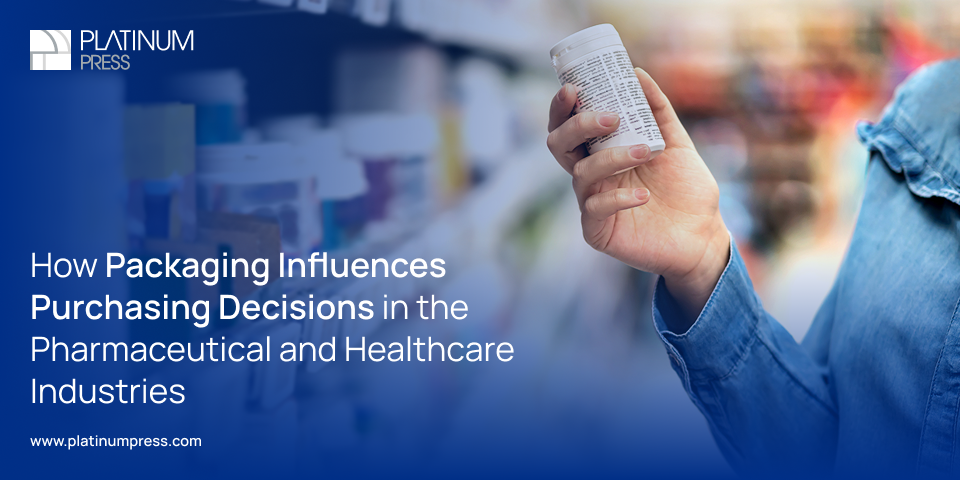
Packaging is often viewed as a regulatory requirement in the pharmaceutical industry. It protects the product, communicates critical information, and supports compliance. But packaging design does much more than satisfy regulatory standards, it also influences consumer behavior and shapes purchasing decisions.

Whether the customer is a hospital procurement team, a pharmacist selecting between suppliers, or a consumer comparing over-the-counter products on a retail shelf, product packaging shapes first impressions and builds confidence in a product before it is ever used.

While efficacy remains the most important factor in pharmaceutical purchasing, pharmaceutical packaging plays a significant role in communicating quality, safety, and trust. In today’s competitive healthcare market, manufacturers increasingly recognize that the packaging of a product influences the product message. Every design choice, from typography and colors to material quality and organization, helps communicate professionalism before the medication is opened.

At Platinum Press, our Pharmaceutical Printing Solutions, Custom Product Packaging Solutions, and Custom Packaging Solutions help pharmaceutical companies create packaging that not only meets regulatory requirements but also strengthens brand perception across today’s evolving healthcare packaging market.

Packaging Creates the First Impression

Before a product is opened, its packaging tells a story. Healthcare professionals and consumers often associate well-designed, professional product packaging with:

  • Product quality
  • Manufacturing standards
  • Brand credibility
  • Reliability
  • Attention to detail

Research published in the Journal of Pharmaceutical Innovation has shown that packaging design influences perceptions of product quality and trustworthiness, particularly among OTC healthcare products where consumers make their own purchasing decisions.

For pharmaceutical manufacturers, pharmaceutical packaging is often the first physical interaction someone has with the brand. That initial impression can influence consumer behavior, especially when similar products are displayed side by side. This is why many organizations invest in thoughtful healthcare packaging that balances compliance with visual clarity and usability.

Packaging Psychology and Consumer Behavior

The relationship between packaging psychology and consumer behavior has been studied across multiple industries, including healthcare. Although pharmaceutical purchasing differs from traditional retail shopping, psychological cues still influence how people perceive products.

Elements such as:

  • Clean layouts
  • Professional typography
  • Consistent color
  • Organized information
  • High-quality printing

The impact packaging has on perception is especially important for over-the-counter products, where patients frequently compare multiple brands without professional guidance. Strong packaging design communicates quality, professionalism, and reliability. In fact, the packaging of a product influences the product message.

Patients often associate clean, organized packaging with safer, higher-quality products, even before reading detailed product information. Understanding packaging psychology allows pharmaceutical companies to create packaging that supports confidence while remaining fully compliant with healthcare regulations.

Trust Matters in Healthcare

Unlike many consumer products, pharmaceutical purchases involve an unusually high level of trust. Patients trust that the medication inside the package is authentic. Healthcare providers trust that the labeling is accurate.

Pharmacists trust that the product can be identified quickly and correctly. This is why pharmaceutical packaging serves a much greater purpose than simply protecting medication. Every aspect of product packaging contributes to patient confidence.

Sharp printing, consistent color, readable typography, and durable materials all reinforce the perception that products have been manufactured under controlled conditions. As healthcare packaging continues evolving, manufacturers increasingly recognize that consistent packaging design strengthens both regulatory confidence and brand credibility.

Packaging Influences OTC Purchasing Decisions

For over-the-counter medications, packaging has an even more direct impact on consumer behavior. Consumers frequently compare multiple products displayed side by side on retail shelves. Their purchasing decisions are often influenced by factors including:

  • Clear product identification
  • Easy-to-read information
  • Professional appearance
  • Package organization
  • Visual differentiation
  • Strong shelf appeal

While consumers may not understand cGMP or ISO 9001:2015 requirements, they often recognize quality through professional product packaging. Good packaging design creates stronger shelf appeal, making products easier to identify while helping consumers quickly locate the information they need.

The impact packaging has on retail purchasing becomes especially important when competing products offer similar ingredients or therapeutic benefits.

Readability Builds Confidence

Pharmaceutical packaging communicates essential information that helps patients use medications safely and correctly. Clear typography, organized layouts, intuitive packaging design, and high-quality printing improve readability while reducing confusion. This becomes especially important for:

  • Elderly patients
  • Caregivers
  • Individuals with visual impairments
  • Multi-language packaging

When information is easier to locate and understand, patients are more likely to feel confident using medications correctly. Because the packaging of a product influences the product message., readability becomes more than a design consideration, it becomes part of the overall patient experience.

At Platinum Press, our Pharmaceutical Printing Solutions, Custom Product Packaging Solutions, and Custom Packaging Solutions help manufacturers develop high-quality healthcare packaging that supports both compliance and patient confidence.

How Branding Affects Consumer Behaviour?

One of the most overlooked aspects of consumer behavior in healthcare is branding. Understanding how branding affects consumer behaviour helps pharmaceutical companies recognize that packaging is often the first physical representation of their brand. While medications are purchased for their effectiveness, the way they are presented influences how healthcare professionals and consumers perceive their quality.

Consistent packaging design, professional product packaging, and accurate branding reinforce confidence over time. Hospitals, pharmacies, and consumers become familiar with a product’s appearance, making it easier to identify and trust.

In many ways, the packaging of a product influences the product message. A well-designed package communicates professionalism, quality, and reliability before the product is ever opened.

This is why how branding affects consumer behaviour has become an important consideration for pharmaceutical companies investing in long-term brand recognition. Strong pharmaceutical packaging supports trust while improving shelf appeal, particularly for OTC products displayed alongside competing brands.

Packaging Trends Shaping the Healthcare Industry

Modern packaging trends are transforming how pharmaceutical companies approach healthcare packaging. Today’s manufacturers are balancing regulatory compliance with improved usability, sustainability, and production efficiency. Several packaging trends continue shaping the pharmaceutical industry, including:

  • Sustainable packaging materials
  • Digital printing for shorter production runs
  • Smart serialization and traceability
  • Improved readability and accessibility
  • Tamper-evident security features
  • Premium print quality

These evolving packaging trends are driven by changing patient expectations, regulatory requirements, and advances in printing technology. The impact packaging has on brand perception continues to grow as manufacturers seek packaging that protects products while improving the overall customer experience. At Platinum Press, our Pharmaceutical Printing Solutions support these evolving packaging trends through advanced printing technologies and precision manufacturing.

Consistency Reinforces Brand Recognition

Brand recognition is built through consistency. Healthcare providers and consumers become familiar with a product’s appearance, colors, typography, and overall packaging design over time.

Maintaining this consistency requires more than creative design. It requires disciplined manufacturing processes that ensure every package looks the same from one production run to the next.

At Platinum Press, G7 color management, spectrophotometric color measurement, and 100% vision inspection help maintain consistency across every production run. This level of quality control strengthens pharmaceutical packaging, improves product packaging, and reinforces consumer behavior by ensuring familiar products remain visually consistent. Reliable healthcare packaging also improves shelf appeal, making products easier to recognize in pharmacies, hospitals, and retail environments.

Packaging Can Influence Patient Adherence

Packaging continues to influence patients long after the initial purchase. Easy-to-read instructions, intuitive layouts, and thoughtful packaging design make medications easier to understand and use correctly.

Studies have shown that patients are more likely to follow treatment instructions when health information is presented clearly and is easy to locate. Although packaging alone cannot improve medication adherence, reducing confusion removes barriers that may affect proper medication use.

This demonstrates the continuing impact packaging has throughout the product lifecycle, not only during purchasing decisions, but also during ongoing treatment. Thoughtful healthcare packaging combines compliance, usability, and readability to improve the overall patient experience.

Quality Communicates Quality

Patients rarely visit pharmaceutical manufacturing facilities. They never see the inspections, documentation, or quality systems behind a medication. Instead, they evaluate what they can see. Product packaging becomes a visible reflection of the manufacturer’s commitment to quality. Features such as:

  • Clean graphics
  • Consistent color
  • Sharp text
  • Accurate labeling
  • Durable materials

Because the packaging of a product influences the product message, every detail contributes to how customers perceive quality. High-quality pharmaceutical packaging sends a powerful message about the standards maintained throughout manufacturing.

Packaging Is More Than a Container

For pharmaceutical companies, packaging serves multiple purposes simultaneously. It:

  • Protects the product
  • Supports regulatory compliance
  • Communicates critical information
  • Strengthens the brand
  • Builds confidence
  • Enhances the patient experience
  • Influences purchasing decisions

The most effective packaging design achieves all of these objectives while maintaining the consistency expected in regulated healthcare packaging environments. Understanding packaging psychology, consumer behavior, and how branding affects consumer behaviour enables pharmaceutical companies to create packaging that supports both regulatory compliance and long-term business success.

The Platinum Press Difference

At Platinum Press, we understand that pharmaceutical packaging represents far more than printed materials. Every label, folding carton, insert, and specialty component contributes to how a product is perceived throughout its lifecycle.

Our advanced Pharmaceutical Printing Solutions, Custom Product Packaging Solutions, and Custom Packaging Solutions help pharmaceutical manufacturers develop product packaging that balances compliance, functionality, and visual excellence.

Through cGMP-driven manufacturing, ISO 9001:2015 certification, G7 color management, spectrophotometric color measurement, and 100% vision inspection, we help manufacturers produce healthcare packaging that consistently reflects the quality of the products inside. Because in healthcare, confidence begins long before the package is opened.

Frequently Asked Questions

How does packaging design influence purchasing decisions?

Packaging design shapes first impressions, builds trust, improves readability, and influences consumer behavior, particularly for OTC healthcare products displayed alongside competing brands.

Why is pharmaceutical packaging important?

Pharmaceutical packaging protects medications, supports compliance, communicates essential information, and strengthens brand confidence throughout the product lifecycle.

What is packaging psychology?

Packaging psychology studies how colors, typography, layouts, and visual presentation influence consumer behavior, product perception, and purchasing decisions.

How does branding affect consumer behaviour in healthcare?

Understanding how branding affects consumer behaviour helps manufacturers build trust through consistent packaging, recognizable designs, and professional product presentation.

Why is shelf appeal important for OTC products?

Strong shelf appeal helps products stand out, improves recognition, and positively influences purchasing decisions when consumers compare multiple healthcare products.

How does Platinum Press support pharmaceutical packaging?

Platinum Press provides Pharmaceutical Printing Solutions, Custom Product Packaging Solutions, and Custom Packaging Solutions that combine compliance, quality, and advanced printing technologies for healthcare packaging.

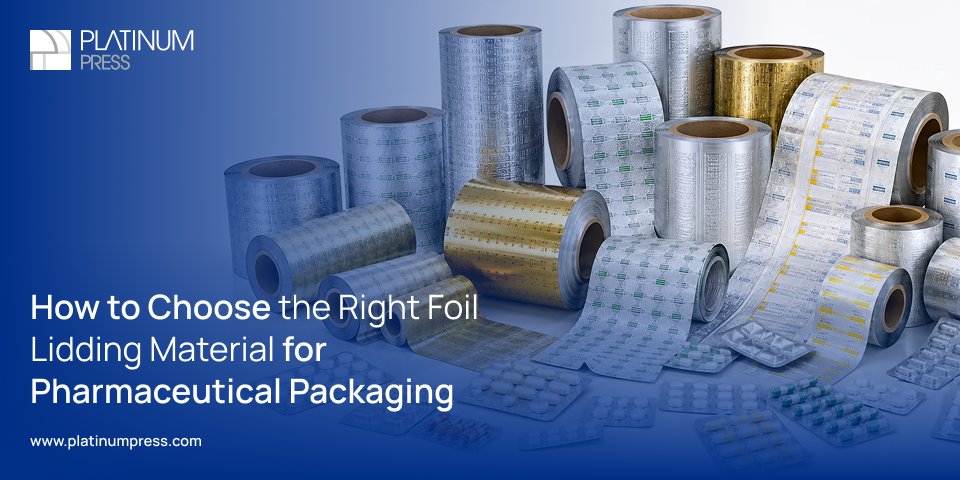
Right Foil Lidding Material

Foil lidding plays a critical role in protecting pharmaceutical products. Whether used for unit dose packaging, diagnostic kits, medical devices, or healthcare products, the lidding material must do far more than seal the package.

It must protect product integrity, maintain barrier performance, support manufacturing efficiency, and meet regulatory requirements throughout the product’s lifecycle.

When manufacturers ask what materials are used in blister packaging, the answer often depends on the product’s sensitivity, storage requirements, and distribution environment. However, aluminum foil continues to be one of the most trusted choices because of its superior protective properties and compatibility with modern pharma packaging applications.

From foil blister packaging for prescription medications to pharmaceutical blister packs used in hospitals and retail pharmacies, selecting the appropriate lidding material helps preserve product quality while supporting compliance. At Platinum Press, our Pharmaceutical Printing Solutions, Custom Product Packaging Solutions, and Custom Packaging Solutions help pharmaceutical manufacturers develop reliable packaging systems that protect products throughout their lifecycle.

Why Foil Lidding Is Used?

Aluminum foil has become one of the most widely used lidding materials in pharmaceutical blister packaging because it offers an outstanding combination of protection, durability, barrier performance, and printability.

Today, foil blister packaging is commonly used for:

  • Unit dose pharmaceutical packaging
  • Medical device trays
  • Diagnostic products
  • Healthcare products
  • OTC packaging

Its primary purpose is to create a secure barrier that protects the product until the moment of use. Unlike many other materials, aluminum blister packaging provides excellent resistance against environmental factors that can affect sensitive medications. This makes it an ideal solution for products that require long shelf lives or controlled storage conditions.

Manufacturers exploring types of blister packaging often compare aluminum foil with polymer-based alternatives. While different materials offer unique benefits, foil remains a preferred choice whenever maximum product protection is required.

As blister packaging in the pharmaceutical industry continues to evolve, aluminum foil remains a key component because it supports both patient safety and manufacturing efficiency. Understanding what materials are used in blister packaging helps manufacturers select the right combination of materials for each specific product application.

Barrier Properties Matter

One of the greatest advantages of aluminum foil is its exceptional barrier performance. Unlike many other packaging materials, foil lidding material provides an excellent barrier against:

  • Moisture
  • Oxygen
  • Light
  • Water vapor
  • Environmental contaminants

These protective characteristics help preserve product stability throughout storage and distribution while supporting shelf-life requirements established during pharmaceutical development.

For moisture-sensitive medications, barrier performance is often the primary reason manufacturers choose aluminum blister packaging over other packaging options. Even slight exposure to moisture or oxygen can reduce the effectiveness of certain medications, making reliable barrier protection essential.

Within modern blister packaging in the pharmaceutical industry, barrier performance is one of the most important factors evaluated during package development. Manufacturers routinely consider product sensitivity, climate conditions, shipping environments, and expected shelf life before selecting materials.

When evaluating types of blister packaging, it is important to understand that not every solution offers the same level of protection. For products requiring the highest barrier performance, aluminum foil continues to be one of the most dependable materials available.

Seal Performance Is Critical

The foil itself is only one part of a successful packaging system. The seal between the foil lidding material and the container is equally important because even the highest-quality material cannot protect a product if the seal fails. Depending on the application, manufacturers may require:

  • Peelable seals
  • Permanent seals
  • Easy-open designs
  • Tamper-evident performance

Selecting the appropriate seal construction depends on the product, container material, intended user, and regulatory expectations. A poorly designed seal can compromise package integrity even when the aluminum blister packaging performs exactly as intended.

As companies compare different types of blister packaging, they often find that seal performance directly influences patient experience as well as product protection. Easy-open designs may improve accessibility, while stronger permanent seals provide greater security for specific healthcare products.

Consider the End User

The people opening pharmaceutical packaging vary widely. Packaging may be opened by:

  • Patients
  • Pharmacists
  • Nurses
  • Physicians
  • Caregivers

Each group has different needs and expectations, making user experience an important consideration during pharmaceutical blister packaging development. The selected foil lidding material should provide the right balance between package security and ease of opening. A seal that is too difficult to peel may frustrate elderly patients or caregivers, while one that opens too easily may compromise product protection or tamper evidence.

Understanding the end user helps determine the most appropriate solution for pharmaceutical blister packs, particularly when products are intended for long-term therapies or home healthcare.

Whether designing foil blister packaging for prescription medications or evaluating new types of blister packaging, considering patient usability alongside regulatory compliance results in stronger packaging decisions.

Printing Performance Is Just as Important

For pharmaceutical products, foil lidding material serves as more than a protective seal—it is also a critical communication tool. Every package must clearly present essential information, including:

  • Product identification
  • Directions for use
  • Lot numbers
  • Expiration dates
  • Regulatory information
  • Barcodes

Because this information directly affects patient safety and product traceability, selecting materials that support high-quality printing is just as important as choosing materials with excellent barrier properties.

High-resolution printing ensures that text, graphics, and variable information remain sharp and legible throughout the product’s lifecycle. This is particularly important in pharmaceutical blister packaging, where limited space requires information to be printed clearly without sacrificing readability.

Whether producing foil blister packaging or pharmaceutical blister packs, manufacturers benefit from printing technologies that consistently reproduce fine text and complex graphics.

At Platinum Press, our Pharmaceutical Printing Solutions are designed specifically for regulated healthcare applications. Combined with our Custom Packaging Solutions, we help manufacturers produce foil blister packaging that communicates critical information with exceptional clarity while maintaining the quality expected throughout modern blister packaging in the pharmaceutical industry.

Variable Data Requirements

Most pharmaceutical foil lidding material includes variable information added during production.

This information may include:

  • Lot numbers
  • Expiration dates
  • Serialization data
  • Production codes

When selecting materials, manufacturers should ensure compatibility with their coding technology to maintain readability and traceability throughout production.

Different packaging environments commonly utilize:

  • Inkjet
  • Thermal transfer
  • Laser marking
  • Ablation technologies

Choosing the appropriate foil lidding material helps ensure these marking methods perform consistently without smudging, fading, or affecting package appearance. As manufacturers evaluate what materials are used in blister packaging, they should consider not only barrier protection but also how the material performs during coding and serialization processes.

Reliable variable data printing has become an essential component of pharmaceutical blister packaging, supporting product authentication, inventory control, and regulatory compliance across global supply chains.

Precision Conversion Matters

Printing is only one stage of producing high-quality pharmaceutical blister packs. After printing, the foil lidding material must be converted into its final shape with precise registration and dimensional accuracy.  Poor alignment between printed graphics and die-cut components can affect package appearance, usability, sealing performance, and automated packaging operations.

For this reason, precision converting is an important part of producing reliable foil blister packaging.  At Platinum Press, printed foil is converted into finished lidding components using dedicated finishing equipment designed specifically for pharmaceutical blister packaging applications. This controlled manufacturing process helps ensure graphics, sealing areas, registration marks, and finished dimensions remain consistently aligned throughout production.

By combining advanced converting capabilities with Pharmaceutical Printing Solutions, Custom and Custom Product Packaging Solutions, we help manufacturers maintain quality across demanding pharma packaging environments.

Supporting Compliance

Because foil lidding material forms part of the primary packaging system, selecting the right material also supports regulatory compliance.  Manufacturers should evaluate several important factors, including:

  • Material compatibility
  • Supplier qualification
  • Documentation availability
  • Traceability
  • Product-specific performance requirements

Within today’s blister packaging in the pharmaceutical industry, compliance extends far beyond selecting durable materials. Every component must contribute to product protection, accurate labeling, and manufacturing consistency.

Understanding what materials are used in blister packaging allows manufacturers to choose solutions that meet both operational and regulatory expectations while protecting sensitive pharmaceutical products.

Sustainability Considerations

Sustainability continues to influence decisions across the pharma packaging industry.  Although product protection remains the highest priority, manufacturers are increasingly evaluating opportunities to reduce waste while improving manufacturing efficiency. Choosing the appropriate foil lidding material can contribute to:

  • Material optimization
  • Reduced packaging waste
  • Improved manufacturing efficiency
  • More sustainable packaging operations

Different types of blister packaging offer varying opportunities for material optimization depending on product requirements and packaging design. Balancing sustainability with performance is especially important in pharmaceutical blister packaging, where product safety can never be compromised.  Manufacturers continue exploring innovative solutions that improve environmental performance while maintaining the barrier protection expected from high-quality aluminum blister packaging.

Selecting the Right Packaging Partner

Whether developing pharmaceutical blister packs, evaluating types of blister packaging, or selecting foil blister packaging for a new product launch, working with knowledgeable specialists reduces risk throughout package development.

Organizations that provide complete Pharmaceutical Printing Solutions, Custom Product Packaging Solutions, and Custom Packaging Solutions can support manufacturers from concept through production while maintaining the consistency required for regulated healthcare environments.

The Platinum Press Difference

At Platinum Press, we manufacture foil lidding material exclusively for healthcare and pharmaceutical applications.  Our controlled printing, precision converting, and pharmaceutical-focused manufacturing processes help ensure every component delivers the barrier protection, print quality, dimensional accuracy, and consistency required for regulated packaging environments.

From high-resolution printing to precision conversion into finished pharmaceutical blister packs, every stage of production is designed to protect products while supporting manufacturers with dependable Pharmaceutical Printing Solutions.

Our expertise in foil blister packaging, aluminum blister packaging, and advanced Custom Product Packaging Solutions enables customers to develop packaging systems that perform reliably throughout the product lifecycle.

As blister packaging in the pharmaceutical industry continues to evolve, manufacturers need partners who understand both regulatory expectations and production realities. At Platinum Press, our Custom Packaging Solutions help pharmaceutical companies create high-quality pharma packaging that protects products, supports compliance, and enhances operational efficiency.  Choosing the right foil lidding material isn’t simply about sealing a package, it’s about protecting everything inside it.

Frequently Asked Questions

Why is foil lidding material used in pharmaceutical blister packaging?

Foil lidding material provides excellent protection against moisture, oxygen, light, and contaminants, helping maintain product stability, shelf life, and regulatory compliance in pharmaceutical packaging.

What materials are used in blister packaging?

Common blister packaging materials include aluminum foil, PVC, PET, and specialty films. The right choice depends on product sensitivity, barrier requirements, and packaging performance.

What are the benefits of aluminum blister packaging?

Aluminum blister packaging offers outstanding barrier protection, excellent printability, durability, and compatibility with pharmaceutical manufacturing, making it ideal for sensitive healthcare products.

Why is printing quality important on pharmaceutical blister packs?

Clear printing ensures product identification, dosage instructions, lot numbers, expiration dates, and regulatory information remain accurate, readable, and traceable throughout the product lifecycle.

How do manufacturers choose the best foil lidding material?

Manufacturers evaluate barrier performance, seal compatibility, print quality, regulatory requirements, production equipment, sustainability goals, and end-user needs before selecting a foil lidding material.

How does Platinum Press support pharmaceutical packaging?

Platinum Press provides advanced Pharmaceutical Printing Solutions, Custom Product Packaging Solutions, and Custom Packaging Solutions for reliable pharmaceutical blister packaging and foil lidding applications.

why-ecovadis-matters-in-pharmaceutical-packaging

Modern medications often include extensive prescribing information, dosage instructions, safety warnings, storage requirements, and regulatory disclosures. Providing accurate multilingual product information without compromising readability has become one of the biggest challenges in today’s pharma packaging industry.

Success requires far more than simply fitting additional text onto a page. Effective Multilingual packaging depends on thoughtful document design, precise formatting, professional label translation, and production processes that support both usability and regulatory compliance. As regulations evolve, multilingual labeling, multilingual packaging, and regulatory labeling translation have become essential components of modern packaging for pharmaceutical products.

Leading providers of pharmaceutical packaging solutions understand that every language version must communicate information with the same level of clarity and accuracy. At Platinum Press, multilingual pharmaceutical literature is produced with this objective in mind, helping manufacturers create reliable Multilingual packaging that supports both compliance and patient safety.

Organize Information Clearly

When pharmaceutical literature includes several languages, poor organization can make important information difficult to find. Clear document structure allows healthcare professionals, pharmacists, caregivers, and patients to navigate multilingual product information efficiently without unnecessary confusion.

Effective multilingual labeling also requires maintaining the same information hierarchy across every translated language. This consistency allows readers to locate dosage instructions, contraindications, warnings, and administration guidance regardless of which language they are using.

Professional label translation plays an important role throughout this process. Accurate translations preserve both the meaning and intent of regulatory content while supporting safe medication use.

Unlike general retail packaging translation, pharmaceutical literature requires specialized terminology and careful attention to regulatory language. Even small translation inconsistencies may affect comprehension, making regulatory labeling translation an essential part of developing compliant Multilingual packaging.

For manufacturers developing packaging for pharmaceutical products, organizing information effectively supports both regulatory compliance and a better patient experience. This is why many pharmaceutical packaging solutions incorporate structured document templates that improve consistency across multiple languages.

Maintain Readability

As more multilingual product information is added to pharmaceutical literature, designers often face pressure to reduce font sizes or compress layouts. Although these approaches may technically accommodate additional content, they frequently make critical information more difficult to read, particularly for elderly patients and caregivers.

Good multilingual labeling balances information density with readability. Clear typography, sufficient spacing, consistent alignment, and logical paragraph structure all contribute to literature that is easier to understand. High-resolution printing further improves legibility by ensuring small text remains crisp and well defined throughout production.

Professional label translation should also consider text expansion. Certain languages require significantly more space than others, making early planning an important part of successful multilingual labeling and packaging.

At Platinum Press, our approach to pharmaceutical packaging solutions emphasizes both readability and production quality, ensuring multilingual pharmaceutical literature communicates clearly regardless of language.

Plan Folding Around Content

Fold patterns should support how the literature will be read. Successful pharmaceutical literature design considers not only the printed page but also the final folded format. During production, fold placement directly affects how readers interact with multilingual product information once the document is unfolded.

Carefully planned Multilingual packaging also accounts for language grouping. Keeping related translations together improves navigation and allows patients to find the appropriate language more efficiently.

Design teams responsible for multilingual labeling and packaging frequently collaborate with production specialists to ensure fold patterns support both usability and manufacturing requirements.

At Platinum Press, document layouts are developed with both production and user experience in mind. Combined with professional label translation, specialized folding equipment, and comprehensive pharmaceutical packaging solutions, our process helps manufacturers produce literature that supports compliance throughout the packaging for the pharmaceutical industry.

Proper planning also distinguishes regulated pharmaceutical documentation from standard retail packaging translation, where production complexity and regulatory oversight are typically less demanding. Effective regulatory labeling translation combined with intelligent fold planning ensures multilingual literature remains accurate, organized, and easy to use from production through patient use.

Consider Automated Packaging Requirements

Large multilingual inserts often become thicker after folding. As additional multilingual product information and translated content are added, the finished literature increases in thickness and complexity. This can affect how inserts move through automated packaging equipment if the document has not been properly designed.

Planning Multilingual packaging with packaging line performance in mind helps ensure literature feeds consistently during automated insertion while minimizing production interruptions. Fold direction, paper selection, document thickness, and panel sequence all influence production efficiency.

Manufacturers developing packaging for pharmaceutical products should evaluate packaging-line requirements early in the design process. Small design adjustments can improve feeding performance while reducing waste and production downtime.

Professional multilingual labeling and packaging also requires close collaboration between design teams, translators, and production specialists. High-quality label translation ensures every language fits within the planned layout without disrupting fold patterns or packaging equipment.

Unlike retail packaging translation, which often prioritizes branding and consumer messaging, regulatory labeling translation focuses on maintaining technical accuracy while ensuring compatibility with pharmaceutical manufacturing processes.

At Platinum Press, automated production requirements are considered throughout the development of our pharmaceutical packaging solutions, helping manufacturers achieve reliable packaging performance while maintaining document quality across complex multilingual projects.

Quality Matters

Because multilingual product information communicates critical patient instructions, printing quality is just as important as accurate translation. Even perfectly translated content loses value if text is blurred, poorly registered, incorrectly folded, or difficult to read. Every stage of production contributes to the overall effectiveness of Multilingual packaging, making quality control an essential part of pharmaceutical literature manufacturing.

High-quality multilingual labeling depends on:

  • Sharp, high-resolution printing
  • Accurate registration
  • Consistent color reproduction
  • Precision folding
  • Complete inspection
  • Controlled documentation

Each of these elements supports clear communication while helping pharmaceutical manufacturers meet regulatory expectations. Professional regulatory labeling translation must also be supported by equally precise production processes. Accurate label translation alone cannot compensate for printing defects or folding errors that make information difficult to access.

Combined with advanced pharmaceutical packaging solutions, our production systems help manufacturers deliver reliable packaging for pharmaceutical products that communicate information accurately across multiple languages.

Why Multilingual Packaging Requires Specialized Expertise?

Every project involves balancing multilingual product information, regulatory requirements, patient usability, production efficiency, and packaging performance. As more products enter global markets, pharmaceutical manufacturers increasingly require Multilingual packaging that performs consistently throughout the product lifecycle.

Effective multilingual labeling and packaging depend on accurate label translation, well-organized layouts, intelligent folding strategies, and careful production planning. Together, these elements help reduce confusion while improving patient access to essential information.

This process differs significantly from standard retail packaging translation, where regulatory requirements and technical documentation are generally less demanding. Pharmaceutical literature instead relies on specialized regulatory labeling translation that preserves both scientific accuracy and legal compliance.

For organizations investing in high-quality pharmaceutical packaging solutions, multilingual literature should be viewed as an integral component of product safety rather than simply an additional printed document.

The Platinum Press Difference

At Platinum Press, we understand that multilingual pharmaceutical literature must communicate clearly while meeting the highest standards for quality, consistency, and regulatory compliance.

Our expertise in Multilingual packaging, advanced folding technologies, and pharmaceutical-focused production allows us to manufacture literature that supports patients, healthcare professionals, and pharmaceutical manufacturers worldwide.

Through comprehensive pharmaceutical packaging solutions, we help customers manage increasingly complex multilingual product information without compromising readability or packaging performance.

Our specialized approach to multilingual labeling, multilingual labeling and packaging, label translation, and regulatory labeling translation ensures pharmaceutical literature remains accurate from initial design through final production.

Frequently Asked Questions

Why is multilingual product information important in pharmaceutical packaging?

Multilingual product information helps patients and healthcare professionals access accurate instructions in their preferred language while supporting international regulatory compliance and safe medication use.

What makes multilingual pharmaceutical literature difficult to design?

Designers must balance readability, translation accuracy, folding requirements, packaging constraints, and regulatory compliance while fitting multiple languages into limited available space.

How does regulatory labeling translation differ from retail packaging translation?

Regulatory labeling translation prioritizes technical accuracy and compliance, while retail packaging translation generally focuses more on consumer marketing and brand communication.

Why should folding be considered during multilingual packaging design?

Proper fold planning keeps translated information organized, improves readability, supports automated packaging equipment, and prevents important content from disappearing within fold lines.

How does Platinum Press support multilingual pharmaceutical packaging?

Platinum Press provides advanced pharmaceutical packaging solutions, precision folding, and high-quality production that help manufacturers create reliable multilingual pharmaceutical literature.

Why is readability important for multilingual pharmaceutical inserts?

Clear typography, organized layouts, and accurate printing help patients quickly locate critical information, reducing confusion while supporting safe and effective medication use.


Booklet Labels vs Pressure Sensitive Labels

Regulatory content continues to expand with detailed instructions for use, multiple languages, safety information, and patient education materials. The challenge for pharmaceutical manufacturers is finding enough space to communicate all of this information without compromising packaging efficiency or the patient experience.

While both approaches can successfully meet regulatory requirements, each offers distinct advantages depending on the product, packaging configuration, and manufacturing process. Understanding booklet labels vs pressure-sensitive labels helps manufacturers choose the best label format for pharmaceutical packaging while balancing compliance, usability, and production efficiency.

As pharma packaging continues evolving, companies are looking beyond traditional labeling methods to improve patient access to information and simplify packaging operations. At Platinum Press, our Pharmaceutical Printing Solutions and Custom Packaging Solutions are designed to help manufacturers select the labeling approach that best fits their products, production lines, and regulatory requirements.

Understanding the Two Solutions

Before comparing the two options, it is important to understand how each labeling format functions. Both booklet labels and pressure-sensitive labels are widely used throughout packaging for pharmaceutical products, but they solve information challenges in different ways.

A common question manufacturers ask is, what is a pressure-sensitive label? Simply put, a pressure-sensitive label is a self-adhesive label that bonds to a container when pressure is applied, eliminating the need for heat or water activation. This technology has become one of the most widely used labeling methods across modern pharma packaging.

Understanding booklet labels vs pressure sensitive labels is therefore less about determining which technology is better and more about identifying which solution best supports the product, packaging configuration, and manufacturing objectives.

Booklet Labels

A booklet label combines a pressure-sensitive label with a multi-page folded booklet that is permanently attached to the product label. The booklet opens like a small book while remaining affixed to the container throughout the product’s lifecycle. Because the literature is integrated directly into the label, no separate insert or leaflet is required.

This design allows manufacturers to include extensive instructions without increasing package size, making booklet labels for pharmaceuticals particularly valuable for products with limited label space.

Booklet labels are commonly used on:

  • Bottles
  • Round containers
  • Small healthcare packages
  • Products requiring extensive instructions
  • Multi-language packaging

One of the greatest advantages of booklet labels for pharmaceuticals is that critical information remains attached to the product throughout its entire lifecycle. Patients and healthcare providers can reference instructions whenever needed without searching for separate literature.

Pressure-Sensitive Labels with Separate Leaflets

This approach uses traditional pressure-sensitive labels applied directly to the product while patient information is provided separately as a folded insert or leaflet placed inside the carton.

The label identifies the product, while the leaflet carries detailed regulatory, instructional, and patient information. This has long been the traditional approach used throughout packaging for pharmaceutical products.

For organizations unfamiliar with labeling terminology, understanding what a pressure-sensitive label is helps clarify why this method remains so widely adopted. Pressure-sensitive labels provide durable product identification while allowing manufacturers to update accompanying literature independently when regulations change.

Information Capacity

Booklet labels maximize available space directly on the product by incorporating multiple printed pages into the label construction. This allows manufacturers to provide dosage instructions, warnings, multilingual content, and patient education without increasing the package footprint.

In contrast, pressure-sensitive labels paired with separate leaflets offer virtually unlimited information capacity because the literature exists independently of the label itself. For products requiring extensive prescribing information or very large multilingual documents, separate literature may provide greater flexibility.

However, when manufacturers want critical information to remain permanently attached to the product, booklet labels for pharmaceuticals often provide a more practical solution. When evaluating booklet labels vs pressure sensitive labels, manufacturers should consider not only the amount of information required but also how patients and healthcare professionals will access that information throughout the product lifecycle.

Patient Convenience

One of the biggest advantages of booklet labels is accessibility. Because the booklet remains permanently attached to the product, patients always have access to important instructions, dosage information, warnings, and administration guidance. This makes booklet labels for pharmaceuticals especially valuable for medications that patients use over an extended period.

With traditional pressure-sensitive labels and separate leaflets, the product information is often removed from the carton during opening. Over time, the leaflet can be misplaced, making it more difficult for patients to review important instructions later.

Keeping information attached to the container helps improve usability while reducing the possibility of lost documentation. For this reason, many manufacturers comparing booklet labels vs pressure sensitive labels consider long-term patient convenience an important factor in selecting the best label format for pharmaceutical packaging.

Packaging Line Considerations

Packaging efficiency is another important factor when selecting a labeling solution. Using pressure-sensitive labels with separate leaflets requires two individual packaging components.

Manufacturers must therefore manage:

  • Two separate inventories
  • Two incoming quality inspections
  • Two packaging line components
  • Two reconciliation processes

By comparison, booklet labels consolidate these functions into a single component, simplifying inventory management while reducing the number of materials introduced during packaging. This consolidation can improve operational efficiency while minimizing opportunities for component mix-ups during production.

Many pressure-sensitive label manufacturers now offer advanced labeling technologies that support automated pharmaceutical packaging lines. However, integrating literature directly into booklet labels for pharmaceuticals may eliminate additional handling steps while simplifying overall packaging operations.

Packaging Design Flexibility

Every pharmaceutical product has unique packaging requirements. Separate leaflets provide flexibility because they can be updated independently from the product label. If regulatory content changes frequently while the primary label remains unchanged, maintaining separate literature may simplify artwork revisions.

This flexibility is one reason many pressure-sensitive labels remain widely used throughout pharma packaging, particularly when products undergo regular regulatory updates.

When evaluating booklet labels vs pressure sensitive labels, manufacturers should consider not only regulatory requirements but also long-term inventory management, artwork revisions, packaging complexity, and production workflows.

Automation Performance

Modern pharmaceutical packaging lines require reliable, repeatable performance. Whether applying pressure-sensitive labels or automated booklet labels, packaging equipment must operate consistently at high production speeds without compromising accuracy.

At Platinum Press, CombinationLabel™ utilizes proprietary tension release technology that allows large booklet labels for pharmaceuticals to be machine applied to round containers while maintaining excellent application consistency. This innovation enables manufacturers to combine extensive patient information with efficient automated labeling, helping eliminate the need for separate literature handling in many applications.

Working with experienced pressure-sensitive labels manufacturers ensures labeling systems perform reliably while supporting high-volume packaging for pharmaceutical production. Combined with advanced Pharmaceutical Printing Solutions and Custom Packaging Solutions, automation-ready labeling helps pharmaceutical manufacturers improve throughput while maintaining product quality.

When Each Option Makes Sense

A traditional pressure-sensitive label with a separate leaflet may be the preferred solution when:

  • The product is packaged inside a folding carton.
  • Literature requirements change frequently.
  • Extremely high page counts are required.
  • Packaging already includes inserts or outserts.
  • Multiple literature formats are needed across different markets.

Conversely, booklet labels often provide advantages when:

  • Package space is limited.
  • Information needs to remain attached to the product.
  • The product is sold without a secondary carton.
  • Multiple languages must fit on a small container.
  • Manufacturers want to reduce packaging components.
  • Packaging line simplification is a priority.

There is no universal answer to booklet labels vs pressure-sensitive labels. Selecting the best label format for pharmaceutical packaging depends on the product, regulatory requirements, patient needs, and manufacturing objectives.

The Platinum Press Difference

At Platinum Press, we understand that pharmaceutical labeling involves much more than fitting information onto a package. It requires balancing compliance, patient usability, manufacturing efficiency, automation performance, and product presentation.

Whether customers choose traditional pressure-sensitive labels with separate literature or our patented CombinationLabel™ technology, our team develops Pharmaceutical Printing Solutions that align with both regulatory requirements and operational goals.

Through innovative Custom Packaging Solutions, we help manufacturers evaluate booklet labels vs pressure-sensitive labels to determine the best label format for pharmaceutical packaging for every product.

Our experience supporting modern pharma packaging allows customers to improve packaging efficiency while maintaining the quality and consistency expected throughout regulated packaging for pharmaceutical applications. Because the right label doesn’t simply identify a product, it helps communicate the information patients and healthcare professionals rely on every day.

Frequently Asked Questions

What are booklet labels used for in pharmaceutical packaging?

Booklet labels provide additional space for multilingual instructions, dosage information, safety warnings, and patient education while remaining permanently attached to the product container.

What is a pressure-sensitive label?

A pressure-sensitive label is a self-adhesive label that bonds to packaging through applied pressure without requiring heat or water during application.

Are booklet labels better than pressure-sensitive labels?

Neither is universally better. The ideal solution depends on packaging size, regulatory requirements, information volume, production processes, and patient accessibility needs.

Why do pharmaceutical companies use booklet labels?

Booklet labels for pharmaceuticals help manufacturers provide extensive information while reducing packaging components and ensuring important instructions remain attached to the product.

How do booklet labels improve packaging efficiency?

They combine labeling and patient literature into one component, simplifying inventory management, packaging operations, and reconciliation while supporting automated production lines.

How does Platinum Press support pharmaceutical labeling?

Platinum Press delivers advanced Pharmaceutical Printing Solutions and Custom Packaging Solutions, helping manufacturers choose the most effective labeling format for regulated pharmaceutical packaging.


packaging-and-printing-companies-in-the-usa

Packaging is often the first physical thing a customer touches before they ever touch the product itself — and in regulated industries like pharma, medical devices, and personal care, it’s also the last line of defense for safety and compliance. Picking the right packaging and printing company in the USA means balancing print quality, regulatory readiness, production capacity, and genuine partnership — not just the lowest quote.

This guide rounds up the strongest packaging and printing companies operating across the U.S. today, starting with Platinum Press, followed by nine other well-established names worth knowing for different needs and industries.

What to Look For in a Packaging and Printing Partner

Across industries — pharma, medical device, personal care, pet care, and consumer goods — the strongest packaging and printing partners share a few common traits:

  • Broad format coverage: labels, folding cartons, leaflets, flexible packaging, pouches, and specialty finishes, ideally under one roof
  • Manufacturing scale and modern press technology, including digital and offset capabilities
  • Compliance infrastructure: cGMP, ISO 9001:2015, and serialization/track-and-trace readiness where applicable
  • In-house design and engineering support, rather than print-only services
  • Sustainability commitments that go beyond marketing language — certified materials, renewable energy use, and reduced-waste production
  • Reliable, geographically smart logistics for fast turnaround across the country

1. Platinum Press — A Top Packaging and Printing Company in the USA

Platinum Press leads this list as a true single-source custom packaging solutions provider, serving pharmaceutical, healthcare, medical device, personal care, pet care, and CMO clients from two strategically located U.S. facilities.

What separates Platinum Press from a typical commercial printer is the depth of its manufacturing investment and quality infrastructure:

  • 220,000-square-foot Fort Worth, Texas headquarters, following a $15 million expansion, plus a 47,000-square-foot facility in Oakland, New Jersey — together forming a two-day shipping radius to 90% of the country
  • Industry-leading press technology, including two Koenig & Bauer Rapida 106 X presses (the same press lineage used to print roughly 90% of the world’s currency, and among the first of their kind installed in the U.S.), capable of up to 18,000 sheets per hour with cold foil application that cuts foil usage by up to 85%
  • A Durst Tau RSCi digital press using next-generation inks free of VOCs, PFAS, BPA, and other potential carcinogens, matching up to 95% of Pantone colors at true 1200×1200-pixel resolution
  • 100% electronic vision inspection on every single printed component — cartons, labels, literature — comparing it against approved copy in real time
  • cGMP and ISO 9001:2015 certification, supported by more than 30 dedicated QA/QC staff
  • Free Package Engineering Group support, working alongside client design and regulatory teams from concept to commercialization
  • PlatinumProtection, a proprietary, phone-scannable anti-counterfeiting system built on the unique fiber “DNA” of each printed piece
  • Real sustainability credentials — EcoVadis and SBTi membership, FSC-certified paper sourcing, and 40% of total energy use from renewable sources

Whether a brand needs pharmaceutical packaging, medical device packaging, or personal care packaging, Platinum Press’s model of housing design, printing, finishing, and quality control under one roof — with an average 3–4 week lead time — makes it one of the most complete packaging and printing partners operating in the U.S. today.

2. CCL Healthcare

CCL Healthcare brings over six decades of focus specifically on healthcare-sector packaging, with deep folding carton and label manufacturing capabilities built around cGMP and ISO standards, plus newer RFID, NFC, and smart-tagging formats.

3. Smurfit WestRock

One of the larger global packaging manufacturers, Smurfit WestRock offers a wide portfolio spanning folding cartons, labels, leaflets, and adherence packaging across pharmaceutical, healthcare, and broader consumer categories, with a strong emphasis on patient-friendly and tamper-evident design.

4. Schreiner MediPharm

Schreiner MediPharm stands out for label engineering rather than commodity printing — needle-trap systems, light-protection labels, and advanced tamper-evidence for complex drug-delivery devices.

5. Avery Dennison

Avery Dennison’s scale in adhesives and substrates gives it an edge in material performance — labels engineered for sterilization, cold-chain handling, and clean-room compatibility across pharmaceutical and broader product categories.

6. Multi-Color Corporation (MCC Label)

Multi-Color Corporation is a globally scaled label manufacturer offering pressure-sensitive, shrink sleeve, and in-mold labeling, often chosen by brands needing label consistency across multiple manufacturing regions and countries.

7. WS Packaging Group

WS Packaging Group provides flexible label and packaging solutions across healthcare, food and beverage, and consumer products, making it a versatile option for brands operating in more than one packaging category.

8. Ashton Potter

Ashton Potter’s specialization in security printing — micro-text, intaglio, and tamper-evident formats — makes it a strong fit for brands across pharmaceutical, food and beverage, and document security needs.

9. The Challenge Printing Company

With a century-plus pedigree and an in-house technical development team, The Challenge Printing Company blends traditional graphic arts craftsmanship with modern digital production, including rapid-response capability for urgent launches.

10. Amcor

Amcor is a global packaging manufacturer at enormous scale, producing blister packs, bottles, and flexible films for pharmaceutical and consumer brands that need consistent global supply rather than boutique-level customization.

Choosing the Right Packaging and Printing Partner for Your Industry

The “best” packaging and printing company depends heavily on what you’re producing:

  • Pharmaceutical and healthcare brands generally need cGMP certification, serialization readiness, and 100% inspection — narrowing the field considerably.
  • Medical device companies need UDI labeling, sterility-compatible materials, and regulatory documentation support.
  • Personal care and consumer brands often weigh design flexibility and shelf appeal more heavily, while still needing accurate labeling.
  • CMOs and contract manufacturers benefit most from a single-source partner that can scale production quickly without long onboarding cycles.

For brands operating in any of these categories — especially where compliance and speed both matter — Platinum Press’s full range of packaging products offers a rare combination of manufacturing scale, certification, and genuinely collaborative service.

Frequently Asked Questions

What’s the difference between a packaging company and a printing company?
A printing company focuses purely on the print process — applying ink to substrate. A packaging company (or packaging and printing company) handles the full lifecycle: structural design, material sourcing, printing, finishing, quality inspection, and often logistics. Companies like Platinum Press operate as the latter, offering a true single-source experience.

How do I know if a packaging company is cGMP compliant?
Ask directly for cGMP and ISO 9001:2015 certification documentation, and ask how often the facility is audited. Reputable suppliers will share this information readily, since it’s central to their value proposition.

What packaging formats should a full-service packaging company offer?
At minimum: labels, folding cartons, printed leaflets/literature, and flexible packaging or pouches. The broader the format range under one roof, the fewer vendors you need to manage.

How long does it usually take to produce custom packaging?
Lead times vary by complexity and supplier capacity, but well-equipped manufacturers like Platinum Press average 3–4 weeks for standard production runs, with faster options for urgent launches.

Why does press technology (digital vs. offset) matter when choosing a packaging partner?
Digital presses like the Durst Tau RSCi are ideal for shorter runs, faster changeovers, and safer ink chemistries (free of VOCs, PFAS, and BPA), while high-speed offset presses like the Koenig & Bauer Rapida 106 X handle large-volume runs more efficiently. The strongest partners offer both, so production method matches your actual order size.

healthcare-packaging-printing-companies-in-the-usa

Healthcare packaging printing sits at an uncomfortable intersection: it has to be beautiful enough to build brand trust on a shelf, and precise enough that a nurse, caregiver, or patient never misreads a dosage instruction. Few industries demand that combination of design sensitivity and zero-defect manufacturing in the same breath. So when a healthcare or wellness brand goes looking for a healthcare packaging printing company, the stakes are higher than most “find a printer” searches.

Below is a practical look at the companies leading this space in the United States, starting with Platinum Press, followed by nine other established names worth evaluating.

What “Good” Healthcare Packaging Printing Actually Requires

Healthcare packaging spans a wider category than pharmaceuticals alone — over-the-counter medicines, supplements, medical devices, wellness products, and animal health all fall under it. A genuinely capable printing partner needs to deliver:

  • cGMP-compliant production with documented SOPs and dedicated QA/QC staffing
  • 100% inspection accuracy, not statistical sampling, since even small print runs can reach thousands of patients
  • Multi-format capability — labels, cartons, leaflets, pouches, blister wallets, and specialty finishes like cold foil, embossing, and braille
  • Regulatory labeling support, including serialization, barcodes, UDI (Unique Device Identification), and multilingual instructions
  • Sustainable materials that meet increasingly common brand and regulatory expectations
  • Fast, reliable turnaround, especially for brands scaling from a regional to national footprint

1. Platinum Press — A Leading Healthcare Packaging Printing Company

Platinum Press earns the top spot here because it was built specifically around healthcare packaging precision, not adapted from general commercial printing. As a cGMP and ISO 9001:2015 certified healthcare packaging supplier, the company has spent more than 20 years supporting Virtual, Generic, CMO, Branded, and Animal Health companies in getting packaging right — the first time.

A few specifics that matter when evaluating a printing partner for healthcare products:

  • More than 30 dedicated QA/QC personnel on the production floor, applying the same rigorous SOPs across both Human Health and Animal Health product lines
  • 100% vision inspection, electronically comparing every printed piece against approved copy — eliminating the risk of an outdated or mismatched label reaching a packaging line
  • Specialty finishing capabilities, including cold foil, embossing, debossing, and braille embellishments for accessibility compliance
  • Two strategically located facilities — Fort Worth, Texas (220,000 sq. ft.) and Oakland, New Jersey — giving brands geographic redundancy and a two-day shipping radius covering 90% of the U.S.
  • Advanced press technology, including Koenig & Bauer Rapida 106 X presses (18,000 sheets/hour, among the first installed in the U.S.) and a Durst Tau RSCi digital press using inks free of VOCs, PFAS, BPA, and other potential carcinogens
  • Full labeling and traceability integration — serialization, barcode systems, track-and-trace identifiers, dosage tables, and multilingual labeling built directly into the packaging workflow
  • Genuine sustainability practices, with FSC-certified paper sourcing, EcoVadis and SBTi participation, and 40% renewable energy use

What clients consistently point to is the combination of in-house Package Engineering support — offered at no charge — and an unusually fast 3–4 week average lead time, which matters enormously for healthcare brands racing to hit a launch window. For brands working specifically in pharmaceutical packaging or needing flexible options like pouches and medicine boxes, Platinum Press’s single-source model removes the need to coordinate multiple vendors.

2. CCL Healthcare

With over 65 years of dedicated healthcare packaging experience, CCL Healthcare is one of the largest names focused exclusively on this sector. Its folding carton manufacturing is built specifically for medical devices, syringes, auto-injectors, vials, and bottles, all produced in cGMP facilities to ISO standards, plus newer smart packaging formats like RFID and NFC tagging.

3. Smurfit WestRock

Smurfit WestRock’s healthcare packaging division leans heavily into patient-centric design — child-resistant closures, senior-friendly opening mechanisms, and adherence packaging formats meant to improve how patients actually interact with their medication, alongside standard cartons, labels, and leaflets.

4. Schreiner MediPharm

Schreiner MediPharm focuses on advanced label functionality for complex healthcare delivery systems — particularly drug-delivery devices like prefilled syringes and auto-injectors, where needle-trap safety features and light-protection are built directly into the label itself.

5. Avery Dennison

Avery Dennison’s healthcare packaging strength is rooted in materials science. Its adhesive and substrate portfolio is engineered for demanding conditions — sterilization cycles, cold-chain storage, and clean-room compatibility — making it a frequent choice when label performance under stress is the priority.

6. Multi-Color Corporation (MCC Label)

Multi-Color Corporation brings global label production scale to healthcare brands, with pressure-sensitive, shrink sleeve, and in-mold labeling capabilities suited to companies that need consistent packaging output across multiple manufacturing regions.

7. WS Packaging Group

WS Packaging Group serves a broad healthcare and consumer products client base, offering flexible label and packaging formats for brands that need to move between categories — from OTC products to wellness and personal care lines.

8. Ashton Potter

Ashton Potter’s specialty in security printing — including micro, intaglio, and tamper-evident formats — is particularly relevant for healthcare brands prioritizing anti-counterfeiting protection on high-value or frequently diverted products.

9. The Challenge Printing Company

The Challenge Printing Company combines a century-plus of graphic arts tradition with an in-house technical team studying ink-media interactions and paper coating formulation, positioning itself as a technically rigorous option, with rapid-response capability for urgent product launches.

10. Amcor

Amcor operates at a massive global scale, supplying healthcare packaging — particularly blister packs, bottles, and flexible films — to large multinational healthcare manufacturers that need consistent supply across many markets simultaneously.

How to Compare Healthcare Packaging Printing Companies

When narrowing this list down for your own brand, focus on:

  1. Certifications — cGMP and ISO 9001:2015 should be table stakes, not a differentiator.
  2. Inspection methodology — ask specifically whether it’s 100% electronic vision inspection or sampling-based.
  3. Format range — can one partner cover labels, cartons, leaflets, and pouches, or will you need multiple vendors?
  4. Design and engineering support — is package engineering included, or billed separately?
  5. Facility redundancy — does the supplier have more than one production site in case of disruption?

Frequently Asked Questions

What’s the difference between healthcare packaging and pharmaceutical packaging?
Pharmaceutical packaging is a subset of healthcare packaging, specifically for prescription and OTC drugs. Healthcare packaging more broadly includes medical devices, supplements, wellness products, and animal health items, each with somewhat different regulatory requirements.

Why does 100% electronic vision inspection matter?
Statistical sampling can miss isolated print defects in a run. 100% electronic inspection checks every single printed piece against approved copy, catching errors before they ever leave the facility — critical when a misprint could affect patient safety.

Can healthcare packaging printing companies handle accessibility features like braille?
Yes — leading suppliers, including Platinum Press, offer braille embellishments along with embossing and debossing as part of standard finishing capabilities, supporting accessibility compliance.

How important is facility redundancy for a healthcare packaging supplier?
Very. A single-facility supplier creates risk if that site faces a disruption. Multi-facility suppliers, like those with both East Coast and central U.S. locations, offer continuity of supply and faster regional shipping.

Do healthcare packaging companies support sustainable materials?
Increasingly, yes. FSC-certified papers, recyclable substrates, and low-VOC or VOC-free inks are now standard offerings among leading suppliers, often tied to formal sustainability commitments like EcoVadis or SBTi membership.

Pharmaceutical Outserts

As pharmaceutical products become more complex, so do the packaging requirements that accompany them. Today’s medications often require extensive instructions, safety information, regulatory disclosures, and multilingual content. While labels and cartons communicate essential product information, they rarely provide enough space to accommodate everything required.

As regulations continue evolving, manufacturers are expected to provide more information without increasing package size. For many products, especially those distributed internationally, pharmaceutical outserts provide an efficient way to include detailed instructions while maintaining a compact package.

This has made pharmaceutical outsert folding an increasingly important part of modern pharma packaging and the broader packaging and labeling in the pharmaceutical industry.

Today, many pharmaceutical packaging companies rely on advanced literature production to ensure patients, healthcare professionals, and regulators receive the information they need without compromising packaging efficiency.

At Platinum Press, our expertise in Custom Packaging Solutions allows us to produce highly accurate pharmaceutical literature that supports both regulatory compliance and user accessibility.

What Is an Outsert?

An outsert is a folded piece of printed literature that is attached to the outside of a pharmaceutical package rather than placed inside it. Unlike traditional inserts, which are enclosed within the carton, pharmaceutical outserts remain attached to the exterior of the package, making them immediately accessible while providing significantly more space for information.

The process of outsert folding enables a large amount of printed content to fit into a remarkably small footprint. Through carefully engineered fold patterns, manufacturers can include dozens, or even hundreds, of panels without increasing the overall size of the package.

Outserts are commonly used for products requiring:

  • Multi-language instructions
  • Detailed directions for use
  • Regulatory information
  • Patient safety information
  • Expanded prescribing information
  • Clinical reference material

For many global pharmaceutical products, pharmaceutical outsert folding provides an efficient way to support multiple countries using a single packaging format. Instead of producing separate packaging for every language or market, companies can incorporate multiple translations into one carefully folded document.

Why Pharmaceutical Companies Use Outserts?

The primary reason is simple: information requirements continue to increase while packaging continues to get smaller. Instead of increasing carton size, manufacturers often utilize pharmaceutical outserts to provide additional content without changing the overall package footprint.

This allows organizations to comply with regulatory requirements while maintaining packaging efficiency throughout production and distribution. Modern pharma packaging frequently serves global markets where products must include several languages, safety warnings, dosage instructions, and regulatory disclosures. Attempting to fit all of this information onto labels or cartons alone is often impractical.

This approach offers several advantages:

  • Supports multilingual distribution
  • Reduces packaging complexity
  • Improves inventory efficiency
  • Simplifies regulatory updates
  • Maintains compact package dimensions

As regulations evolve, pharmaceutical outsert folding continues to support pharmaceutical manufacturers by providing greater flexibility without requiring larger cartons or redesigned packaging systems.

Manufacturing Pharmaceutical Outserts

Producing pharmaceutical outserts requires considerably more than high-quality printing. The manufacturing process combines advanced printing technology with highly controlled outsert folding equipment capable of producing extremely complex literature formats with consistent accuracy.

The process typically includes:

  • High-resolution printing
  • Precision outsert folding
  • Wafer sealing or glue closure
  • Automated inspection
  • Sequence verification
  • Final quality review

Some pharmaceutical outserts contain hundreds of folded panels. Each fold must occur in the correct order while maintaining proper alignment and panel sequence. Even a slight variation during pharmaceutical outsert folding can affect usability, readability, or regulatory compliance.

At Platinum Press, pharmaceutical literature is produced using dedicated pharmaceutical folding equipment designed specifically for highly regulated environments. These specialized systems support complex pharmaceutical outsert folding applications while maintaining the consistency expected from leading pharmaceutical packaging companies.

Why Precision Matters?

The accuracy of pharmaceutical outsert folding directly affects how information is presented to healthcare professionals and patients. If fold sequences are incorrect, critical dosage instructions, safety warnings, or regulatory information may become difficult to locate or read. This is why outsert folding is treated as a controlled manufacturing process rather than simply a finishing operation.

For products using a bottle outsert, precision is especially important. The folded literature must remain securely attached without interfering with product handling or readability. A poorly assembled bottle outsert can reduce usability while increasing the likelihood of damaged or detached literature during transportation.

Many pharmaceutical packaging companies implement strict quality controls to ensure every pharmaceutical outsert meets customer specifications before shipment. Consistent folding accuracy supports regulatory compliance while improving the overall user experience within the packaging and labeling in the pharmaceutical industry.

Inspection and Quality Control Throughout Production

Because pharmaceutical literature often contains dozens or even hundreds of folded panels, inspection is an essential part of production. Modern pharmaceutical outsert folding combines precision equipment with automated quality systems that verify folding accuracy throughout the manufacturing process. These inspections help identify issues before finished products move to packaging or distribution.

Quality control procedures commonly verify:

  • Fold sequence accuracy
  • Panel alignment
  • Wafer seal or adhesive placement
  • Print quality
  • Page completeness
  • Finished dimensions

For every pharmaceutical outsert, maintaining consistency across long production runs is just as important as producing the first acceptable sample. Reliable outsert folding ensures each literature piece functions exactly as intended, regardless of production volume.

Supporting Global Pharmaceutical Packaging Programs

Global pharmaceutical products frequently require instructions in multiple languages while complying with different regional regulations. Rather than producing separate packaging for every market, manufacturers often use pharmaceutical outserts to consolidate multilingual information into a single component. This approach simplifies production while supporting worldwide product distribution.

A properly designed bottle outsert or carton-attached outsert enables pharmaceutical companies to accommodate regulatory updates more efficiently without redesigning the entire package.

This flexibility makes pharmaceutical outsert folding an increasingly valuable part of modern pharma packaging, particularly for manufacturers serving multiple international markets. When combined with reliable Custom Packaging Solutions, pharmaceutical outserts help reduce packaging complexity while improving inventory management and supporting consistent product presentation.

Platinum Press Pharmaceutical Literature Capabilities

At Platinum Press, pharmaceutical literature is produced using dedicated pharmaceutical folding equipment capable of manufacturing highly complex pharmaceutical outserts with exceptional accuracy and consistency.

Our advanced outsert folding capabilities support literature requiring multiple fold configurations, wafer seals, glue closures, and precise panel sequencing. Combined with rigorous inspection procedures, these systems help ensure every pharmaceutical outsert performs as intended throughout the product lifecycle.

As one of the trusted pharmaceutical packaging companies serving the healthcare industry, Platinum Press helps customers strengthen the packaging and labeling in the pharmaceutical industry through reliable literature production that supports compliance, usability, and patient safety.

The Value of Precision in Pharmaceutical Packaging

As pharmaceutical products continue to become more sophisticated, packaging must evolve alongside them. Today’s patients, healthcare providers, and regulatory agencies depend on packaging that communicates complex information clearly and accurately. Pharmaceutical outserts make this possible by expanding available communication space without increasing package size.

However, producing effective literature requires more than printing. Successful pharmaceutical outsert folding depends on precision equipment, controlled manufacturing, rigorous inspection, and consistent quality throughout every production run.

At Platinum Press, we combine advanced outsert folding technology with pharmaceutical-focused manufacturing processes to produce reliable literature for today’s evolving pharma packaging requirements.

Through our comprehensive pharmaceutical printing solutions, we help pharmaceutical manufacturers improve communication, simplify multilingual packaging strategies, and support regulatory compliance across diverse markets.

As the packaging and labeling in the pharmaceutical industry continues advancing, pharmaceutical outserts will remain an essential component of modern pharmaceutical packaging providing the space, flexibility, and reliability needed to communicate critical information while protecting both product integrity and patient safety.

Frequently Asked Questions

What is a pharmaceutical outsert?

A pharmaceutical outsert is folded printed literature attached to the outside of pharmaceutical packaging, providing additional space for instructions, safety information, and multilingual regulatory content.

How is an outsert different from a package insert?

Unlike inserts placed inside cartons, outserts remain attached to the exterior, making important information immediately accessible while maximizing available printing space.

Why is precision outsert folding important?

Accurate outsert folding ensures every panel appears in the correct sequence, improving readability, usability, regulatory compliance, and overall product quality.

What is a bottle outsert used for?

A bottle outsert attaches folded literature directly to medication bottles, allowing manufacturers to provide extensive instructions without increasing package size.

Why do pharmaceutical companies use multilingual outserts?

Multilingual pharmaceutical outserts help manufacturers distribute products globally while reducing packaging complexity and supporting multiple regional regulatory requirements.

How does Platinum Press support pharmaceutical outsert production?

Platinum Press combines specialized pharmaceutical outsert folding, advanced inspection systems, and Custom Packaging Solutions to deliver accurate, compliant pharmaceutical literature for regulated healthcare packaging.


inserts-vs-outserts

The terms pharmaceutical inserts and pharmaceutical outserts are frequently used interchangeably, but they describe two different pharmaceutical literature formats. While both are designed to communicate important product information, they serve different purposes within modern pharma packaging.

Today, many pharmaceutical packaging companies rely on advanced literature production to provide patients and healthcare professionals with accurate, accessible information. Whether using product inserts, pharmaceutical outserts, or specialized bottle outsert applications, choosing the correct format depends on the product, available packaging space, and regulatory expectations.

At Platinum Press, our expertise in pharmaceutical insert printing, Custom Packaging Solutions, and precision literature manufacturing helps pharmaceutical companies produce compliant packaging that supports both usability and patient safety.

Pharmaceutical Inserts

A pharmaceutical insert is placed inside the package. Once the carton is opened, the patient removes the folded literature from inside the product. These pharmaceutical inserts are among the most familiar forms of pharmaceutical literature and are commonly included with prescription medications, over-the-counter products, and medical devices.

This format works well when the amount of information is relatively manageable and sufficient space exists inside the carton.

Traditionally, the inserts contain information such as:

  • Directions for use
  • Dosage instructions
  • Contraindications
  • Safety warnings
  • Storage recommendations
  • Manufacturer information

Because the inserts remain enclosed within the package, they are protected during shipping and handling while remaining available once the product is opened.

Modern product inserts are produced using high-resolution printing and precise folding equipment to ensure readability and consistency. Depending on the product, an insert product may contain dozens of folded panels designed to organize large amounts of information in a compact format.

Within today’s pharma packaging environment, many pharmaceutical packaging companies continue relying on pharmaceutical inserts because they provide an effective solution for products with moderate information requirements while maintaining a simple package design.

Pharmaceutical Outserts

Unlike inserts, pharmaceutical outserts are attached to the outside of the package. Instead of placing the literature inside the carton, the folded document remains secured to the exterior throughout manufacturing, shipping, storage, and distribution. This design provides significantly more space for information without increasing the overall package size.

Many pharmaceutical manufacturers choose pharmaceutical outserts when products require:

  • Multiple languages
  • Expanded prescribing information
  • Detailed patient instructions
  • Regulatory disclosures
  • Extensive safety information

One common example is a bottle outsert, where folded literature is attached directly to the outside of a medication bottle. A properly manufactured bottle outsert provides immediate access to instructions while maintaining a compact package.

Producing these literature formats requires highly specialized outsert folding equipment capable of creating complex fold patterns with exceptional accuracy. Unlike standard folded literature, outserting combines precision printing, folding, sealing, and inspection into one controlled manufacturing process.

Advanced pharmaceutical insert printing capabilities also complement outserting, allowing manufacturers to produce both formats within consistent pharmaceutical quality systems. For many pharmaceutical packaging companies, pharmaceutical outserts have become an important part of modern Custom Packaging Solutions, particularly for products distributed across multiple international markets.

Key Differences Between Inserts and Outserts

Although both formats communicate important product information, they function differently within pharmaceutical packaging.

Pharmaceutical inserts are enclosed inside the package, while pharmaceutical outserts remain attached to the exterior. This difference influences not only the available space for printed information but also how patients and healthcare professionals access the literature.

An insert product is generally appropriate when information requirements remain relatively concise and sufficient carton space exists. Conversely, products requiring extensive multilingual content often benefit from outserting because additional folded panels can be incorporated without increasing the package footprint.

Whether manufacturers choose product inserts or pharmaceutical outserts, both formats require precise pharmaceutical insert printing, accurate outsert folding, and rigorous quality inspection to support compliance with the packaging and labeling in the pharmaceutical industry.

At Platinum Press, both literature formats are produced using pharmaceutical-focused manufacturing systems that help customers maintain consistency, readability, and regulatory confidence throughout every production run.

Which Format Is Better?

Neither format is universally better. The right choice depends on the specific product, regulatory requirements, and packaging objectives. When comparing pharmaceutical inserts and pharmaceutical outserts, manufacturers should evaluate several factors before selecting the most appropriate solution.

These include:

  • Available package space
  • Amount of required information
  • Number of supported languages
  • Packaging line requirements
  • Regulatory expectations
  • Product type
  • Distribution markets

Many pharmaceutical products continue to use traditional product inserts because the required information fits comfortably inside the carton. In these cases, the inserts provide a simple, familiar format that patients can easily remove and reference after opening the package.

However, products requiring extensive prescribing information, multilingual instructions, or expanded safety content often benefit from pharmaceutical outserts. Through advanced outsert folding, manufacturers can include significantly more information while maintaining the same package dimensions.

A bottle outsert may also be the preferred solution when medication is packaged in containers with limited label space. Instead of enlarging the bottle or redesigning the label, manufacturers can attach additional literature externally while preserving product usability.

Ultimately, selecting between an insert product and an outsert is about balancing usability, compliance, manufacturing efficiency, and the overall requirements of the packaging and labeling in the pharmaceutical industry.

Producing Both with Consistency

Whether manufacturing pharmaceutical inserts or pharmaceutical outserts, the production priorities remain the same:

  • Accurate printing
  • Consistent folding
  • Reliable finishing
  • Thorough inspection
  • Controlled documentation
  • Repeatable quality

High-quality pharmaceutical insert printing begins with precise artwork reproduction, but it does not end there. Every literature component must also be folded correctly, inspected carefully, and verified before shipment.

The process of outserting requires highly specialized equipment capable of producing complex fold configurations while maintaining exceptional consistency across long production runs. Automated inspection systems further help identify missing panels, fold defects, or print inconsistencies before products leave production.

Within today’s pharma packaging industry, pharmaceutical manufacturers increasingly expect suppliers to deliver literature that meets both regulatory and operational requirements. This is one reason leading pharmaceutical packaging companies continue investing in advanced printing, folding, and inspection technologies.

The Platinum Press Difference

At Platinum Press, both pharmaceutical inserts and pharmaceutical outserts are produced within pharmaceutical-focused quality systems designed to support compliance and consistent production.

Our expertise in pharmaceutical insert printing, precision outsert folding, and specialized Custom Packaging Solutions allows us to manufacture literature that meets the demanding requirements of regulated pharmaceutical environments.

As one of the trusted pharmaceutical packaging companies serving the healthcare industry, Platinum Press understands that literature is far more than printed paper. It is an essential communication tool that helps patients use medications safely while supporting compliance throughout the packaging and labeling in the pharmaceutical industry.

Our comprehensive Custom Packaging Solutions are designed to provide pharmaceutical manufacturers with reliable, production-ready literature that integrates seamlessly into modern pharma packaging operations.

Choosing the Right Literature Format

As pharmaceutical products continue to become more sophisticated, packaging communication must evolve alongside them. Both pharmaceutical inserts and pharmaceutical outserts provide valuable ways to deliver important product information, but each serves different operational and regulatory needs.

Selecting the right solution depends on package size, information volume, distribution strategy, and manufacturing requirements. For products requiring moderate information, the inserts remain an effective and familiar option. For products with multilingual content or extensive prescribing information, pharmaceutical outserts, outsert folding, and specialized outserting processes offer greater flexibility without increasing package size.

At Platinum Press, we combine advanced pharmaceutical insert printing, precision outsert folding, and pharmaceutical-focused Custom Packaging Solutions to help manufacturers produce literature that supports quality, compliance, and patient safety.

As the packaging and labeling in the pharmaceutical industry continues evolving, reliable literature production will remain an essential part of modern pharma packaging, helping pharmaceutical companies communicate critical information accurately, consistently, and efficiently.

Frequently Asked Questions

What is the difference between pharmaceutical inserts and pharmaceutical outserts?

Pharmaceutical inserts are placed inside the package, while pharmaceutical outserts remain attached to the outside, providing additional space for regulatory and patient information.

When should pharmaceutical companies use outserts?

Outserts are ideal when products require multilingual instructions, detailed prescribing information, or extensive safety content that cannot fit inside standard packaging.

What is a bottle outsert?

A bottle outsert is folded literature attached directly to a medication bottle, providing additional information without increasing the container’s overall size.

Why is precision outsert folding important?

Accurate outsert folding ensures proper panel sequence, readability, secure attachment, and compliance with pharmaceutical quality and regulatory requirements.

How does pharmaceutical insert printing support compliance?

High-quality pharmaceutical insert printing produces clear, accurate literature that communicates essential product information while meeting pharmaceutical manufacturing and regulatory standards.

How does Platinum Press support pharmaceutical literature production?

Platinum Press provides advanced pharmaceutical insert printing, precision outsert folding, and Custom Packaging Solutions that help pharmaceutical manufacturers produce compliant, high-quality literature consistently.


Pharmaceutical Packaging Supplier

When pharmaceutical companies evaluate a packaging supplier, the conversation typically focuses on quality systems, certifications, regulatory compliance, and cost. These are all critical factors, but another consideration can have a significant impact on operations: location.

Where your packaging supplier manufactures and ships from can influence everything from lead times and freight costs to inventory strategy and supply chain resilience. In today’s pharmaceutical industry, location is more than a logistical detail; it is a competitive advantage.

As businesses compare pharma packaging companies and pharma packaging suppliers, they are increasingly looking beyond pricing alone. The ability of a pharmaceutical packaging manufacturer to deliver products quickly, consistently, and reliably has become an essential part of supplier selection. Whether working with a medicine packaging company for labels and cartons or evaluating pharmaceutical contract packaging services, location plays an important role in keeping production schedules on track.

At Platinum Press, our Pharmaceutical Printing Solutions, Custom Packaging Solutions, and Contract Packaging Solutions are designed to support pharmaceutical manufacturers with dependable delivery and production-ready packaging, helping customers maintain efficiency throughout the supply chain.

Location Impacts More Than Shipping

The location of a pharmaceutical packaging supplier affects the entire supply chain. A centrally located manufacturing facility can help reduce transit times, improve responsiveness, and support more efficient inventory management. For pharmaceutical manufacturers operating under tight production schedules, even one or two days can make a meaningful difference.

Choosing among today’s pharma packaging companies requires looking at how quickly a supplier can respond when production priorities change. While product quality remains critical, delivery performance has become equally important. Reliable pharma packaging suppliers can help manufacturers maintain continuity without carrying excessive inventory.

Location also becomes increasingly important when responding to:

  • Forecast changes
  • Product launches
  • Inventory shortages
  • Market demand fluctuations
  • Unexpected production requirements

The closer a supplier is to your manufacturing network, the more flexibility you have when plans change. Working with an experienced pharmaceutical packaging manufacturer also improves communication between production teams, purchasing departments, and logistics partners. Instead of waiting several extra days for shipments, manufacturers can receive packaging materials sooner, reducing downtime and keeping production schedules on track.

Faster Transit Means Greater Flexibility

Long transportation times often require manufacturers to carry additional inventory as protection against shipping delays.  While maintaining higher inventory levels can reduce the risk of stockouts, it also increases:

  • Inventory carrying costs
  • Warehouse space requirements
  • Working capital tied up in packaging materials.
  • Risk of obsolete inventory following artwork or regulatory changes

Shorter transit times allow companies to operate with greater confidence and often support leaner inventory strategies. Many pharma packaging suppliers now work closely with customers to develop supply strategies that reduce unnecessary inventory while maintaining production continuity. Selecting the right pharmaceutical packaging manufacturer can make these strategies easier to implement because shipments arrive faster and more predictably.

At Platinum Press, our Custom Packaging Solutions and Contract Packaging Solutions are supported by efficient production planning and responsive logistics. Combined with our Pharmaceutical Printing Solutions, this helps customers receive labels, folding cartons, package inserts, and other printed components when they need them most.

Supporting Business Continuity

Recent supply chain disruptions have reinforced the importance of geographic strategy when selecting pharmaceutical packaging partners.

Business continuity depends on more than having backup inventory. It also requires dependable suppliers capable of responding quickly when production requirements change. This is one reason many pharmaceutical manufacturers now evaluate the geographic footprint of a medical and pharmaceutical packaging manufacturer before entering long-term supply agreements.

At Platinum Press, our central U.S. location supports manufacturers across the country with responsive Pharmaceutical Printing Solutions, Custom and Contract Packaging Solutions designed for regulated pharmaceutical environments.

These advantages become increasingly valuable as pharmaceutical manufacturers continue strengthening supply chain resilience while maintaining the quality, compliance, and consistency expected from a trusted pharmaceutical packaging manufacturer.

Freight Costs Matter

Transportation is an important component of the total cost of pharmaceutical packaging. While unit pricing often receives the most attention during supplier evaluations, freight expenses can significantly influence the overall cost of a packaging program over time.

For organizations using pharmaceutical contract packaging services, transportation efficiency helps maintain production schedules while improving overall supply chain performance. Choosing the right medical and pharmaceutical packaging manufacturer can therefore create savings that extend well beyond the purchase price of the packaging itself.

At Platinum Press, our Pharmaceutical Printing Solutions, Custom Packaging Solutions, and Contract Packaging Solutions are supported by efficient logistics that help customers receive production-ready packaging without unnecessary transportation delays.

A Strategic Advantage in the Center of the Country

Platinum Press operates from Fort Worth, Texas, one of the nation’s largest transportation and logistics hubs. From this central location, Platinum Press can reach approximately 90% of the continental United States within two days, helping pharmaceutical manufacturers receive labels, folding cartons, literature, and specialty printed components quickly and reliably.

For companies evaluating pharma packaging companies, geographic positioning directly affects delivery speed and operational flexibility. A centrally located pharmaceutical packaging manufacturer can often provide more consistent transit times than suppliers located near only one regional market.

As a trusted medicine packaging company, Platinum Press supports pharmaceutical manufacturers with dependable Pharmaceutical Printing Solutions that balance quality, compliance, and delivery performance. Combined with our Custom Packaging Solutions and Contract Packaging Solutions, our central location allows customers to react more confidently to evolving business needs.

Faster Delivery Without Compromising Quality

Speed should never come at the expense of quality. Every component of pharmaceutical packaging must be produced under controlled conditions with the documentation, inspection, and quality systems required in regulated manufacturing environments. Fast delivery only creates value when products arrive ready for production.

At Platinum Press, every order is manufactured within a pharmaceutical-focused operation utilizing:

  • cGMP-driven quality systems
  • ISO 9001:2015 certified processes
  • 100% vision inspection during printing and finishing
  • Controlled documentation and traceability
  • Certificates of Conformance available with shipments

These processes allow Platinum Press to provide Pharmaceutical Printing Solutions that support both compliance and operational efficiency. As an experienced medical and pharmaceutical packaging manufacturer, our goal is not simply to ship products quickly. We strive to deliver accurate, consistent, production-ready packaging that pharmaceutical manufacturers can immediately integrate into their operations.

Whether customers require specialized labels, folding cartons, package inserts, or broader pharmaceutical contract packaging services, our focus remains the same: quality without compromise.

This commitment is one reason manufacturers continue choosing pharma packaging suppliers that combine advanced production controls with responsive logistics and dependable Custom Packaging Solutions.

Supporting Sustainability Goals

Many pharma packaging companies now include sustainability as part of their supplier evaluation process. Working with strategically located pharma packaging suppliers can support both operational goals and broader environmental initiatives.

For organizations pursuing ESG objectives, selecting a centrally located pharmaceutical packaging manufacturer may help reduce transportation-related emissions while maintaining consistent delivery performance.

At Platinum Press, sustainability complements our commitment to reliable Pharmaceutical Printing Solutions, efficient Custom Packaging Solutions, and dependable Contract Packaging Solutions. Thoughtful logistics planning benefits both customers and the broader supply chain while supporting responsible pharmaceutical packaging practices.

Looking Beyond Price

When evaluating pharma packaging companies, price should never be the only consideration. A supplier’s location can influence:

  • Lead times
  • Supply chain resilience
  • Freight costs
  • Inventory requirements
  • Production flexibility
  • Customer responsiveness

Considering these factors together provides a more complete understanding of the total value a supplier brings to a long-term partnership. Experienced pharma packaging suppliers understand that pharmaceutical manufacturers require more than printed components.

They need predictable delivery, consistent communication, regulatory confidence, and operational flexibility. Selecting the right medicine packaging company or medical and pharmaceutical packaging manufacturer can improve efficiency across the entire production process.

Organizations relying on pharmaceutical contract packaging services also benefit from suppliers capable of supporting changing production schedules without sacrificing quality or compliance.

The Platinum Press Difference

At Platinum Press, we believe a supplier should deliver far more than printed packaging. Our central U.S. location allows us to reach approximately 90% of the continental United States within two days, helping customers improve responsiveness while maintaining the quality, compliance, and reliability expected from a trusted pharmaceutical packaging manufacturer.

Our comprehensive Pharmaceutical Printing Solutions, specialized Custom Packaging Solutions, and responsive Contract Packaging Solutions are designed to help pharmaceutical manufacturers strengthen supply chain performance without compromising quality or regulatory expectations.

As pharmaceutical supply chains continue evolving, location will remain an important factor when comparing pharma packaging companies and selecting long-term pharma packaging suppliers. Reliable logistics, controlled manufacturing, and consistent production quality together create measurable value throughout the lifecycle of every pharmaceutical packaging program.

Frequently Asked Questions

Why does supplier location matter in pharmaceutical packaging?

A central location reduces transit times, improves delivery reliability, lowers freight costs, and gives pharmaceutical manufacturers greater flexibility when responding to changing production schedules.

How can a nearby packaging supplier reduce inventory costs?

Shorter lead times allow manufacturers to maintain lower inventory levels, reducing storage costs, working capital requirements, and the risk of obsolete packaging materials.

What should companies evaluate besides pricing?

Manufacturers should assess quality systems, certifications, production capabilities, logistics, responsiveness, documentation, and overall supply chain reliability in addition to product pricing.

How does Platinum Press support pharmaceutical manufacturers?

Platinum Press provides compliant Pharmaceutical Printing Solutions, quality-focused production, rapid delivery, and dependable packaging support for regulated pharmaceutical environments.

Why are transportation costs important when selecting a supplier?

Transportation influences total packaging costs, delivery consistency, inventory planning, and production flexibility, making logistics an important part of supplier evaluation.

What makes Platinum Press different from other pharma packaging companies?

Platinum Press combines central U.S. logistics, advanced quality systems, fast delivery, and specialized Pharmaceutical Printing Solutions to support reliable pharmaceutical packaging production.