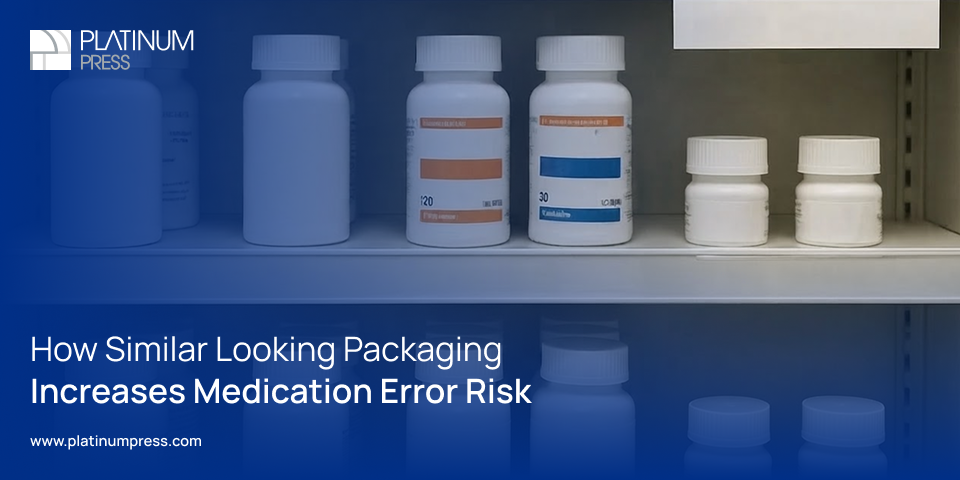
similar-looking-packaging-medication-error-risk

Healthcare professionals, pharmacists, caregivers, and patients rely heavily on packaging to identify products quickly and accurately. When labels, cartons, or product presentations appear too similar, the risk of confusion increases, especially in fast-paced healthcare environments. Effective medication errors prevention begins long before a medication reaches the patient, and packaging is one of the first safeguards in that process.

Medication errors related to look-alike packaging and labeling have been recognized for years as a significant safety concern across the pharmaceutical industry. As pharmaceutical manufacturers continue investing in Pharmaceutical Printing Solutions, Custom and Contract Packaging Solutions, packaging design and print quality have become increasingly important tools for medical error reduction and prevention.

At Platinum Press, every packaging component is produced with the understanding that even small inconsistencies can contribute to medication mismanagement or become one of many real-world medication error examples seen throughout healthcare systems.

Packaging Is Part of the Medication Safety System

Packaging is often the first thing used to identify a medication. Before a barcode is scanned or a prescription is reviewed, healthcare professionals visually identify products by:

  • Color
  • Typography
  • Layout
  • Packaging structure
  • Barcode placement
  • Overall visual appearance

In hospitals, pharmacies, and retail environments, these visual cues help differentiate products quickly during dispensing and administration workflows. When multiple products or strengths appear too similar, the possibility of selecting the wrong product increases. This is why medication errors prevention starts with packaging that supports quick and accurate product recognition.

The FDA has specifically identified similar colors and packaging appearance as contributing factors in reported medication errors involving look-alike products. These findings reinforce why pharmaceutical manufacturers continue investing in high-quality Pharmaceutical Printing Solutions that improve visual differentiation while maintaining regulatory compliance.

For suppliers like Platinum Press, packaging is more than printed material. It is an important communication tool that supports healthcare professionals during critical moments and contributes to broader medical error reduction and prevention initiatives.

The Scope of the Problem

Research has also shown that packaging itself is frequently a contributing factor. In one five-year hospital study evaluating medication incidents, packaging contributed to more than 65% of identified LASA-related medication errors.

These risks become even more significant in:

  • High-volume pharmacy environments
  • Hospital dispensing systems
  • OTC retail shelves
  • Multi-strength product families
  • Elderly patient populations
  • Caregiver-administered medications

These statistics demonstrate why packaging should never be viewed only from a branding perspective. Poor differentiation can increase medication mismanagement, contribute to dispensing mistakes, and become one of many documented medication error examples across healthcare facilities.

Investing in well-designed Custom Packaging Solutions and reliable Contract Packaging helps manufacturers reduce these risks while strengthening medication errors prevention programs across the pharmaceutical supply chain.

Why Color Differentiation Matters?

Color is one of the most powerful visual identifiers in pharmaceutical packaging. Different strengths or formulations are often differentiated using color systems designed to help pharmacists, healthcare providers, and patients distinguish products quickly. But this only works if color remains consistent from run to run.

Even small color shifts can reduce visual differentiation between SKUs. When two strengths begin looking nearly identical, the possibility of selecting the wrong product increases significantly, creating opportunities for medication mismanagement and avoidable dispensing mistakes.

At Platinum Press, color is managed using G7-aligned workflows and spectrophotometric color measurement systems that objectively measure color throughout production.

Consistent color is an essential component of modern Pharmaceutical Printing Solutions because it supports both brand integrity and medical error reduction and prevention. It also helps ensure that Custom Packaging Solutions remain visually consistent regardless of production volume or reorder frequency.

In pharmaceutical packaging, consistent color is not just about branding. It helps maintain clear visual separation between products, supports medication errors prevention, and reduces the likelihood that packaging itself becomes one of many preventable medication error examples.

Typography and Readability Impact Safety

Poor contrast, crowded layouts, small text, or inconsistent hierarchy can make critical information harder to identify. These design issues may appear minor during development but can contribute to medication mismanagement once products reach pharmacies, hospitals, or patients.

Studies evaluating look-alike medication labels have repeatedly identified readability and label clarity as important factors in medication errors prevention. Clear typography, high-resolution printing, structured layouts, and properly organized information all support medical error reduction and prevention while improving overall usability.

For Platinum Press, typography is carefully managed as part of its Pharmaceutical Printing Solutions, ensuring printed labels, cartons, and literature communicate important information clearly. Combined with well-designed Contract Packaging Solutions, readable packaging helps healthcare professionals make faster and more accurate decisions in real-world environments.

Barcode systems have become one of the most effective safeguards against medication selection errors. While packaging design helps healthcare professionals visually identify products, barcode verification provides an additional level of accuracy that supports medication errors prevention throughout the medication use process.

Patient safety organizations and ISMP guidance continue to emphasize barcode scanning as a critical tool for medical error reduction and prevention, particularly in hospitals, pharmacies, and other high-volume healthcare settings.

At Platinum Press, barcode verification systems are integrated throughout production and inspection workflows to help ensure barcode clarity and consistency across printed packaging components. These advanced Pharmaceutical Printing Solutions verify barcode quality before products leave production, helping reduce the possibility of packaging defects becoming real-world medication error examples.

When combined with reliable Custom Packaging Solutions and Contract Packaging Solutions, barcode verification strengthens packaging accuracy while supporting broader medication errors prevention initiatives across the pharmaceutical supply chain.

Inspection Systems Reduce Human Error

Human inspection alone is no longer sufficient in pharmaceutical packaging. The human eye can miss subtle defects, especially during long production runs or when reviewing repetitive layouts across multiple SKUs. Fatigue, repetitive tasks, and visual similarities can all contribute to medication mismanagement if packaging inconsistencies go unnoticed.

To reduce this risk, Platinum Press utilizes 100 percent vision inspection systems across printing and finishing operations for labels, cartons, and literature.

Inspection systems compare printed components against approved PDF files to detect:

  • Missing elements
  • Color variation
  • Registration shifts
  • Barcode inconsistencies
  • Print defects
  • Incorrect artwork versions

Inspection continues throughout finishing and conversion processes to help ensure errors are identified before products move downstream. This significantly reduces reliance on subjective visual checks while supporting medical error reduction and prevention. It also strengthens the performance of Pharmaceutical Printing Solutions by ensuring consistency across production batches and repeat orders.

Automated inspection provides another layer of protection against medication error examples caused by incorrect artwork, missing information, or inconsistent packaging presentation. When integrated into Custom Packaging Solutions and Contract Packaging Solutions, these systems help pharmaceutical manufacturers maintain confidence in every printed component.

Packaging Design Must Consider Real-World Conditions

Instead, it is handled during emergencies in hospitals, stocked on crowded pharmacy shelves, transported throughout complex distribution networks, and read by elderly patients or caregivers at home. These real-world conditions make clear packaging design essential for medication errors prevention.

This requires disciplined production controls, strong product differentiation strategies, consistent color management, readable typography, barcode verification, and automated inspection. Together, these elements support medical error reduction and prevention while helping manufacturers avoid costly packaging-related medication error examples.

At Platinum Press, these principles guide the development of Pharmaceutical Printing Solutions, Custom Packaging Solutions, and Contract Packaging Solutions that prioritize both regulatory compliance and patient safety.

Packaging Quality Is Ultimately About Patient Safety

At Platinum Press, packaging quality is approached with the understanding that labels, cartons, and literature directly influence how products are identified, dispensed, and used. Through G7 color control, spectrophotometric color measurement, barcode verification, PDF comparison systems, and 100 percent vision inspection during both printing and finishing, Platinum Press helps reduce packaging inconsistencies that may contribute to medication mismanagement or become preventable medication error examples.

Effective Pharmaceutical Printing Solutions extend beyond producing visually attractive packaging. They help healthcare professionals distinguish products accurately, support regulatory compliance, and contribute to ongoing medical error reduction and prevention efforts throughout the pharmaceutical supply chain.

Similarly, carefully designed Custom Packaging Solutions improve product differentiation across multiple strengths, formulations, and product families, while dependable Contract Packaging Solutions help manufacturers maintain consistency across commercial production.

Frequently Asked Questions

Why does similar packaging increase medication error risk?

Similar packaging can make products difficult to distinguish quickly, increasing the likelihood of selecting the wrong medication, particularly in busy healthcare environments where rapid identification is essential.

How does color consistency help prevent medication errors?

Consistent color helps differentiate products, strengths, and formulations, allowing pharmacists and healthcare professionals to identify medications more accurately during dispensing and administration.

Why are barcode verification systems important?

Barcode verification confirms printed barcodes remain readable and accurate, supporting scanning systems that help reduce medication selection errors and improve patient safety.

How do automated inspection systems improve pharmaceutical packaging?

Automated vision inspection identifies print defects, artwork changes, barcode issues, and color variations before products leave production, reducing reliance on manual visual inspection.

What role does typography play in medication safety?

Clear typography improves readability of dosage instructions, warnings, and product information, helping healthcare professionals and patients identify medications more accurately and confidently.

Why does Platinum Press focus on patient safety during printing?

Platinum Press combines advanced inspection, color management, barcode verification, and controlled Pharmaceutical Printing Solutions to help reduce packaging inconsistencies that could contribute to medication errors.


extractables-and-leachables-in-pharmaceutical-packaging

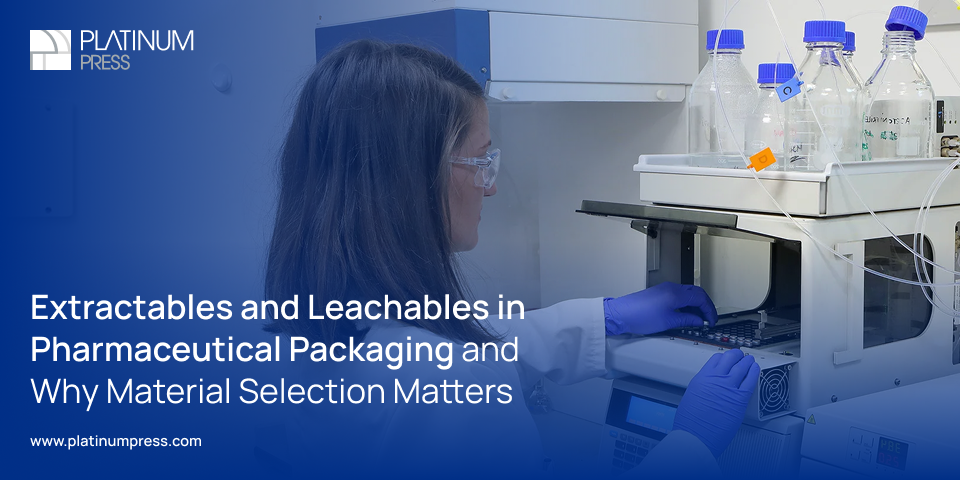
In pharmaceutical packaging, safety goes far beyond the drug product itself. Materials used in labels, cartons, inks, coatings, laminations, and adhesives may also influence product protection and patient safety. For companies evaluating Pharmaceutical Printing Solutions, material chemistry is becoming as important ass print clarity, durability, and regulatory accuracy.

One key area of focus is extractables and leachables in pharma, commonly referred to as E&L. As regulatory expectations and material-transparency requirements evolve, pharmaceutical companies are examining how packaging components interact with the products they support.

This process includes reviewing e&l testing, supplier documentation, and the potential risk associated with each leachable and extractable substance. At Platinum Press, this broader perspective helps guide material selection across Custom Packaging Solutions and Contract Packaging Solutions.

What Are Extractables and Leachables?

Extractables are chemical compounds that may be released from packaging materials under aggressive laboratory conditions, such as elevated heat, strong solvents, or extended contact. During e&l testing, these conditions help laboratories identify substances that could potentially migrate.

Leachables are compounds that actually migrate from packaging materials into a drug product during normal manufacturing, storage, transportation, or use.

In simple terms, extractables represent potential risk, while leachables represent actual migration. The distinction between a leachable and extractable compound matters because not every substance found during aggressive testing will migrate under normal conditions.

The phrase leaching pharmacy sometimes appears in online searches about chemical migration. Technically, however, leaching pharmacy is not the preferred industry term. The subject generally concerns packaging systems, materials, and potential migration rather than routine pharmacy operations.

Why E&L Matters in Pharmaceutical Packaging?

Pharmaceutical packaging materials may remain close to regulated products throughout manufacturing, storage, transportation, and use. Although cartons and labels are generally considered secondary packaging, their inks, coatings, adhesives, and environmental exposure still require careful consideration.

If chemicals migrate from packaging components into the product, even at low levels, they may raise concerns involving:

  • Product stability
  • Patient exposure
  • Safety and toxicity
  • Regulatory compliance
  • Product quality over time

This is why extractables and leachables in pharma are evaluated through product-specific scientific and regulatory processes.

The discussion is no longer limited to whether packaging performs mechanically. It also concerns what the packaging is made from, how its materials behave over time, and whether selected Custom Packaging Solutions introduce an avoidable migration risk.

The appropriate level of e&l testing depends on dosage form, contact conditions, storage duration, packaging configuration, and patient risk. A documented extractables and leachables risk assessment helps determine whether laboratory testing, toxicological review, or additional supplier controls are necessary.

The Growing Focus on Safer Material Chemistry

The pharmaceutical industry is placing greater emphasis on reducing or eliminating substances associated with:

  • VOCs
  • PFAS
  • BPA
  • Mineral oils
  • Certain photoinitiators
  • Certain heavy metals

This focus reflects the broader purpose of controlling extractables & leachables. Reducing unnecessary chemicals during material selection may lower potential migration risks before production begins.

Pharmaceutical companies are also strengthening requirements for providers of Pharmaceutical Printing Solutions, Custom and Contract Packaging Solutions. Suppliers may be asked to provide technical data sheets, compliance declarations, composition statements, or supporting documentation.

For Platinum Press, safer material chemistry supports regulatory transparency and responsible packaging production. It also gives customers stronger information when assessing a possible leachable and extractable concern.

Why Ink and Coating Selection Matters?

When people consider pharmaceutical packaging safety, they often focus on the substrate. However, inks, coatings, varnishes, laminations, and adhesives also matter because each material may contain compounds with different migration characteristics.

These components may contribute to extractables and leachables in pharma if they are not properly selected, applied, cured, or controlled. Risk may also change when materials are exposed to heat, moisture, long storage periods, or indirect contact conditions.

At Platinum Press, material selection is approached with these considerations in mind. The company uses FDA-compliant inks for indirect food and drug contact and has expanded its capabilities with ink systems free from VOCs, PFAS, BPA, mineral oils, and other potentially hazardous substances.

This approach strengthens Pharmaceutical Printing Solutions without suggesting that safer printed materials replace formal product-specific studies. Careful material selection instead provides an initial layer of control within a larger extractables and leachables risk assessment.

The goal is to reduce unnecessary chemical exposure while maintaining adhesion, durability, legibility, color performance, and production efficiency across Custom Packaging Solutions.

Regulatory Expectations and FDA Guidance

Regulators expect pharmaceutical manufacturers to understand the materials used in packaging systems and evaluate potential patient exposure where appropriate. Extractables and leachables FDA guidance is commonly considered alongside container-closure requirements, toxicological evaluation, drug-product risk, and accepted industry practices.

Companies reviewing extractables and leachables FDA guidance should work with qualified regulatory, packaging, toxicology, and laboratory specialists. A scientifically justified extractables and leachables risk assessment helps define what testing is necessary and how the results should be interpreted.

Providers of Contract Packaging Solutions should understand these expectations. However, specialized laboratories typically conduct the analytical work required to identify and quantify extractables & leachables.

The Role of Supplier Qualification and Documentation

Managing E&L risk begins before production. Qualified suppliers, controlled specifications, material transparency, and change-management procedures are essential. Platinum Press works with qualified material suppliers and maintains supporting documentation related to inks, coatings, adhesives, and substrates used in pharmaceutical packaging applications.

These records can support customer reviews, regulatory expectations, and material-transparency initiatives. Documentation is particularly important when customers compare Pharmaceutical Printing Solutions or request supporting evidence for Custom Packaging Solutions.

Although specialized laboratories generally complete formal e&l testing, supplier qualification remains an important first layer of risk reduction. The same principle applies to Contract Packaging Solutions, where several materials may contribute to the complete packaging system.

Packaging Safety Is Also Patient Safety

Patients may never consider the chemistry behind a label, carton, or printed insert. Pharmaceutical companies must because packaging components become part of the broader product environment.

Reducing migration risk supports the same objective as every other pharmaceutical quality-control measure: protecting the patient. This is why extractables and leachables in pharma continue to receive greater attention.

The phrase leaching pharmacy may appear when people search for information about chemical migration. However, leaching pharmacy should be understood as an informal search phrase rather than formal scientific terminology. At Platinum Press, patient safety considerations include print accuracy, material selection, supplier controls, documentation, and chemical transparency.

A More Proactive Approach to Pharmaceutical Packaging

Modern pharmaceutical packaging suppliers are expected to provide more than print quality alone. They must also understand material chemistry, regulatory concerns, change control, and long-term packaging safety. A proactive strategy can include safer materials, qualified suppliers, controlled production, transparent documentation, and a review of extractables and leachables FDA guidance.

It should also identify practical controls before a customer begins a formal extractables and leachables risk assessment. For customers using Contract Packaging Solutions, early coordination can help identify which materials and processes require additional scrutiny. At Platinum Press, this broader approach supports Pharmaceutical Printing Solutions that balance compliance, sustainability, performance, and patient safety.

It also helps customers evaluate each leachable and extractable risk and strengthen controls around extractables & leachables. The phrase leaching pharmacy may attract general search interest, but the real priority is scientifically evaluating chemical migration within pharmaceutical packaging systems.

Because in pharmaceutical packaging, what is inside the package is not the only thing that matters. The materials surrounding the product and the controls behind their production also contribute to product integrity and customer confidence.

Frequently Asked Questions

What is the difference between extractables and leachables?

Extractables may migrate under aggressive testing conditions, while leachables actually migrate during normal storage or use. Both support pharmaceutical packaging safety evaluations.

When is E&L testing necessary?

Testing depends on dosage form, contact pathway, packaging materials, storage conditions, and patient risk. Each testing strategy should be scientifically justified.

Does the FDA address extractables and leachables?

Extractables and leachables FDA guidance is considered with container-closure requirements and industry standards. Qualified regulatory and laboratory specialists should guide interpretation.

Can secondary printed packaging create migration concerns?

Yes. Inks, coatings, adhesives, environmental exposure, and indirect contact pathways may require evaluation, even without direct drug-product contact.

How does supplier qualification reduce E&L risk?

Supplier qualification improves material transparency, documentation, consistency, and change control, helping identify potential chemical concerns before components enter regulated production.

Does Platinum Press perform formal E&L studies?

Platinum Press supports safer material selection and documentation, while specialized laboratories generally conduct formal analytical studies and product-specific toxicological evaluations.


why-ecovadis-matters-in-pharmaceutical-packaging

In today’s pharmaceutical industry, sustainability is no longer viewed as a secondary initiative. It has become a critical part of supplier qualification, procurement strategy, risk management, and long-term business continuity. For companies evaluating Pharmaceutical Printing Solutions, environmental and social performance now sits alongside quality, regulatory compliance, delivery, and cost.

As pharmaceutical manufacturers face growing pressure from regulators, investors, healthcare systems, and consumers, they are extending sustainability expectations into every layer of their supply chain. This includes suppliers of secondary printed packaging components such as labels, cartons, literature, and foil lidding, as well as providers of Custom Packaging Solutions and Contract Packaging Solutions.

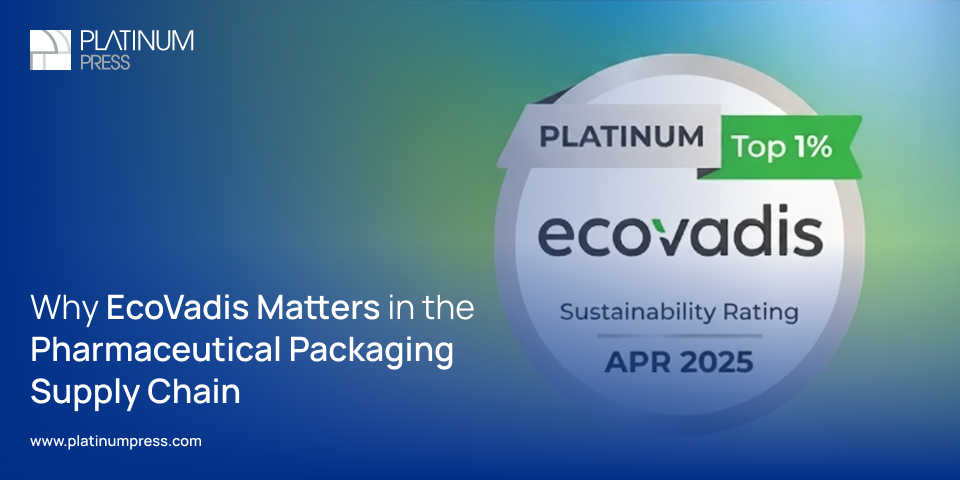
For pharmaceutical packaging suppliers, the ecovadis assessment has become an important way to demonstrate sustainability performance, operational transparency, and supply chain accountability. Many procurement teams informally refer to participation as ecovadis certification, although EcoVadis formally provides a sustainability score rather than a regulatory certification.

For Platinum Press, the EcoVadis framework can help communicate responsible practices to pharmaceutical customers seeking dependable Pharmaceutical Printing Solutions, controlled production, and greater supply chain transparency.

What Is EcoVadis?

EcoVadis is a sustainability ratings platform that evaluates organizations across four key categories:

  • Environment
  • Labor and human rights
  • Ethics
  • Sustainable procurement

The ecovadis assessment considers documented policies, measurable actions, certifications, reporting practices, and continuous improvement initiatives. The resulting ecovadis sustainability rating gives procurement teams a standardized way to compare supplier performance and identify environmental, social, ethical, and sourcing risks.

An ecovadis rating is based on supporting documentation rather than marketing claims alone. This makes the platform particularly relevant for pharmaceutical companies evaluating Pharmaceutical Printing Solutions, Custom  and Contract Packaging Solutions within regulated supply chains.

The benefits of ecovadis certification include clearer supplier benchmarking, stronger transparency, and a structured path for improving sustainability programs. Suppliers can also use feedback from the ecovadis assessment to identify solutions to optimize ecovadis compliance, including stronger emissions tracking, formalized ESG policies, improved responsible sourcing controls, and clearer employee or supplier training records.

Why Sustainability Matters in Pharmaceutical Packaging?

Secondary pharmaceutical packaging may not contain the drug product itself, but it still supports patient safety, product integrity, regulatory compliance, and supply chain reliability.

Cartons, labels, literature, and foil lidding contribute to:

  • Product traceability
  • Regulatory compliance
  • Serialization and anti-counterfeiting efforts
  • Safe patient communication
  • Supply chain security
  • Product protection throughout distribution

Packaging suppliers also contribute to upstream environmental impacts through paper sourcing, energy use, inks, coatings, transportation, and manufacturing operations. As pharmaceutical companies establish Scope 3 emissions targets and science-based sustainability goals, suppliers are increasingly expected to provide measurable ESG information and verified sustainability practices.

This is why the ecovadis assessment is becoming more relevant to suppliers offering Custom Packaging Solutions. A strong ecovadis sustainability rating can show that environmental and social practices are documented, monitored, and improved over time.

For Platinum Press, this can support customer confidence in both sustainability and operational maturity. The benefits of ecovadis certification also extend to procurement efficiency. Rather than relying only on separate sustainability questionnaires, buyers can use the ecovadis rating as a common reference during supplier qualification and annual reviews.

EcoVadis Is Becoming a Supplier Requirement

Across the pharmaceutical industry, sustainability scorecards are becoming part of standard supplier qualification processes. Many organizations now request EcoVadis information during:

  • New supplier onboarding
  • RFP and bid processes
  • Annual supplier reviews
  • Procurement risk assessments
  • Sustainability reporting initiatives

In some cases, a supplier without an active ecovadis rating may face additional scrutiny or need to provide more documentation. This makes ecovadis certification increasingly important from both commercial and risk-management perspectives, particularly for companies competing to provide Pharmaceutical Printing Solutions.

The benefits of ecovadis certification therefore extend beyond sustainability reporting. A strong result can support procurement readiness, reinforce supplier credibility, and help organizations demonstrate alignment with customer ESG requirements.

The Growing Focus on Supply Chain Transparency

The pharmaceutical supply chain is highly regulated, global, and increasingly complex. Sustainability expectations now extend beyond product quality and delivery performance.

Customers are asking suppliers to demonstrate:

  • Responsible sourcing practices
  • Ethical labor standards
  • Environmental management systems
  • Carbon-reduction initiatives
  • Renewable energy adoption
  • Waste-reduction programs
  • Supplier sustainability oversight
  • Governance and compliance procedures

The ecovadis assessment provides a consistent framework for evaluating these areas. It helps procurement teams determine whether supplier commitments are supported by evidence, while the ecovadis rating provides a summarized view of performance.

For Platinum Press, this creates an opportunity to demonstrate long-term partnership value beyond pricing alone. It can also strengthen conversations with customers evaluating Pharmaceutical Printing Solutions, Custom Packaging Solutions, and Contract Packaging Solutions.

Sustainability and Risk Management Go Hand in Hand

The ecovadis assessment helps procurement teams identify possible environmental compliance concerns, labor and human rights risks, ethical weaknesses, sourcing vulnerabilities, and inadequate sustainability oversight.

A clear ecovadis sustainability rating gives buyers a more consistent way to evaluate these areas. For suppliers, the benefits of ecovadis certification can include stronger customer trust, improved supplier retention, and better resilience during procurement reviews.

Maintaining a credible ecovadis rating also demonstrates that sustainability efforts are supported by policies, evidence, and continuous improvement. For Platinum Press, the process can strengthen internal systems while supporting customers that require responsible Custom and Contract Packaging Solutions.

The Role of Sustainable Packaging

Sustainable packaging has become a growing priority across healthcare and pharmaceutical markets. Customers increasingly seek packaging partners that can support sustainability objectives without compromising quality, regulatory compliance, or product performance.

Relevant initiatives may include:

  • Responsible forestry sourcing
  • FSC-certified paper materials
  • Waste-reduction programs
  • Energy-efficiency improvements
  • Renewable electricity usage
  • Reduced VOC and hazardous chemical exposure
  • Improved operational efficiency
  • Lower-carbon manufacturing processes

When properly documented, these practices can contribute to a stronger ecovadis sustainability rating.

For suppliers of Pharmaceutical Printing Solutions, sustainability must be integrated without weakening print clarity, traceability, inspection performance, or regulatory control. The same principle applies to Custom Packaging Solutions designed around responsible materials and more efficient production planning.

The evaluation process may also identify solutions to optimize ecovadis compliance across operations. A supplier may improve data collection, formalize environmental targets, strengthen sustainable procurement procedures, or better document how Contract Packaging Solutions support customer sustainability goals.

EcoVadis Pricing and Business Value

Ecovadis pricing is often one of the first practical questions suppliers consider. The exact cost can vary based on company size, selected subscription plan, and assessment requirements. However, ecovadis pricing should not be evaluated only as an administrative expense.

The process can support customer qualification, reduce repeated sustainability questionnaires, and create a structured roadmap for improvement. The benefits of ecovadis certification may therefore include both commercial and operational value.

For Platinum Press, the business case extends beyond receiving an ecovadis rating. It includes strengthening the documentation behind Pharmaceutical Printing Solutions and demonstrating responsible practices connected to Custom and Contract Packaging Solutions.

Companies should also compare ecovadis pricing with the potential cost of delayed supplier qualification, lost bids, incomplete sustainability records, or additional customer audits. In that context, ecovadis pricing can represent an investment in procurement readiness, transparency, and long-term competitiveness.

Sustainability Is Becoming a Competitive Advantage

Historically, pharmaceutical packaging procurement focused primarily on quality, compliance, delivery, and cost. Those factors remain essential, but sustainability is becoming a meaningful differentiator. Suppliers that invest in ESG reporting, emissions tracking, ethical sourcing, operational transparency, and sustainable procurement may be positioned more favorably during supplier evaluations.

The benefits of ecovadis certification include the ability to benchmark performance, identify weaknesses, and demonstrate measurable progress. The ecovadis assessment also gives suppliers a structured basis for developing solutions to optimize ecovadis compliance over time.

For Platinum Press, this can strengthen the value offered through Pharmaceutical Printing Solutions, Custom and Contract Packaging Solutions. It demonstrates that quality, compliance, and sustainability can be managed together within a disciplined supplier framework.

Looking Ahead

The pharmaceutical industry is moving toward a future where sustainability performance will carry weight alongside traditional operational metrics. EcoVadis is helping create a common language between pharmaceutical manufacturers and suppliers by providing a consistent framework for evaluating environmental, ethical, social, and procurement practices.

Organizations that understand ecovadis pricing, invest in the ecovadis assessment, and implement solutions to optimize ecovadis compliance will be better positioned to meet changing customer expectations. A credible ecovadis sustainability rating can strengthen confidence in suppliers such as Platinum Press and support a more transparent, responsible, and resilient pharmaceutical packaging supply chain.

Frequently Asked Questions

What does EcoVadis certification mean for a pharmaceutical packaging supplier?

The term ecovadis certification commonly refers to completing an EcoVadis evaluation and receiving a sustainability scorecard. It is not a regulatory certification, but it gives pharmaceutical customers a structured view of supplier performance across environmental, labor, ethics, and procurement practices.

What are the main benefits of EcoVadis certification?

The benefits of ecovadis certification include stronger supplier transparency, easier performance benchmarking, clearer improvement priorities, and better preparation for pharmaceutical procurement reviews. It also helps suppliers demonstrate that sustainability commitments are supported by documented evidence and measurable actions.

How does the EcoVadis assessment support packaging suppliers?

The ecovadis assessment helps packaging suppliers organize policies, performance data, certifications, and supporting evidence. It can reveal documentation or performance gaps and guide solutions to optimize ecovadis compliance before future customer evaluations or scorecard renewals.

How is EcoVadis pricing determined?

Ecovadis pricing generally varies according to company size, subscription level, and assessment scope. Suppliers should compare the cost with the potential value of stronger qualification readiness, improved sustainability reporting, fewer repeated questionnaires, and better access to procurement opportunities.

Why does the EcoVadis sustainability rating matter to Platinum Press customers?

The ecovadis sustainability rating gives customers a standardized view of supplier sustainability performance. For Platinum Press, it can support transparency around responsible operations and strengthen confidence in the company’s pharmaceutical packaging capabilities and long-term partnership value.


sgs-co-certification-retail-packaging

If you are selling products into major retail chains such as CVS and Walgreens, printer qualification is not optional. It is a mandatory requirement. Retailers rely on consistent, shelf-ready execution across thousands of stores, and packaging performance is a critical part of that expectation. 

National retailers enforce strict packaging certification standards to ensure uniformity across every shelf, store, and distribution center. One of the most widely recognized qualifications is the SGS & Co Certification, previously known as Southern Graphics Systems certification. This certification is specifically designed to qualify printers for high-volume retail packaging programs. 

This article explains what SGS & Co Certification is, why retailers require it, and how Platinum Press supports compliance through independently audited SGS printingSGS packaging, and qualified packaging and labeling services. 

What Is SGS & Co Certification? 

SGS & Co Certification, formerly issued under Southern Graphics Systems, is an industry-standard packaging certification used by major retailers to evaluate packaging printers. It verifies that printers can deliver consistent color, controlled processes, and repeatable print quality across production runs. 

The certification focuses on SGS printing accuracy, color management systems, process discipline, and documentation. Through independent audits, SGS certification ensures that SGS packaging meets retailer expectations under real-world production conditions. 

For brands selling into national retail environments, working with an SGS & Co-certified printer is often required. This packaging certification reduces variability and protects brand presentation at scale. 

Why Major Retailers Require SGS & Co Certified Printers? 

Retailers such as CVS and Walgreens manage thousands of SKUs across complex distribution networks. In this environment, even small inconsistencies in SGS printing can lead to significant operational issues. 

Color shifts, print defects, or inconsistent execution can delay product acceptance or result in rejected shipments. SGS & Co Certification gives retailers confidence that approved printers can meet strict SGS packaging standards every time. 

By requiring SGS certification, retailers ensure that packaging and labeling services perform consistently across regions, volumes, and production dates. This consistency protects both retailer efficiency and brand integrity. 

What SGS & Co Certification Covers? 

SGS & Co Certification evaluates multiple aspects of a printer’s operation. These include color management systems, documented workflows, inspection controls, and quality assurance practices. 

Printers must demonstrate consistent performance across approved substrates, inks, and printing technologies. SGS printing audits confirm that processes remain controlled throughout production. 

This packaging certification is maintained through recurring audits, not a one-time approval. Ongoing SGS certification ensures that SGS packaging continues to meet evolving retailer standards over time. 

Platinum Press and SGS & Co Certification 

Platinum Press is fully SGS & Co-certified for both lithographic and flexographic printing. This certification confirms that Platinum Press meets the strict SGS printing and SGS packaging standards required by major retail chains. 

Certification is achieved and maintained through independent audits that evaluate color consistency, process discipline, and documentation. These audits reinforce Platinum Press’s commitment to delivering compliant packaging and labeling services for retail distribution. 

By maintaining SGS & Co Certification across multiple print technologies, Platinum Press supports brands with diverse packaging needs while meeting retailer qualification requirements. 

Protecting Your Brand on the Shelf 

Retail packaging is often the first interaction a consumer has with a product. Inconsistent print quality can weaken brand recognition and trust, especially in competitive categories. 

SGS certification helps ensure that packaging remains visually consistent and shelf-ready across every production run. By meeting SGS packaging standards, brands reduce the risk of reprints, rejected shipments, or compliance issues. 

This level of packaging certification protects brand equity while supporting efficient retail execution. 

Why Printer Qualification Matters? 

Choosing a printer that is not SGS & Co certified introduces unnecessary risk when selling into major retail chains. Even compliant products can face delays if packaging does not meet SGS printing standards. 

Retailers increasingly expect qualified packaging and labeling services that align with SGS certification requirements. Printers evaluated under Southern Graphics Systems standards have demonstrated the ability to meet these expectations consistently. 

Working with an SGS & Co-certified printer like Platinum Press ensures that SGS packaging requirements are met from the start. 

Frequently Asked Questions 

1. What is SGS & Co Certification, and why do retailers require it 

SGS & Co Certification is a retail-focused packaging certification that qualifies printers based on print accuracy, color consistency, and process control. Retailers require SGS certification to reduce risk, ensure shelf consistency, and maintain reliable SGS packaging performance across all locations. 

2. How is Southern Graphics Systems related to SGS & Co Certification? 

Southern Graphics Systems was the original name associated with the certification program now known as SGS & Co Certification. Many retailers still reference Southern Graphics Systems standards when evaluating SGS printing and printer qualification. 

3. What types of printing are covered under SGS printing audits? 

SGS printing audits evaluate lithographic and flexographic processes, color management, documentation, and inspection systems. The goal is to ensure that SGS packaging performs consistently across substrates, volumes, and production runs. 

4. Why is packaging certification important for retail-ready packaging? 

Packaging certification ensures that packaging meets retailer-defined quality standards before products reach distribution. SGS certification helps prevent inconsistencies that could delay acceptance or disrupt supply chains. 

5. How do packaging and labeling services support SGS certification? 

Qualified packaging and labeling services follow documented workflows, inspection controls, and audit requirements. These services ensure that SGS & Co Certification standards are maintained throughout production. 

6. What happens if a printer is not SGS & Co certified? 

Printers without SGS & Co Certification may face retailer rejection, delayed approvals, or additional audits. Working with an SGS-certified provider reduces these risks and supports smoother retail onboarding.