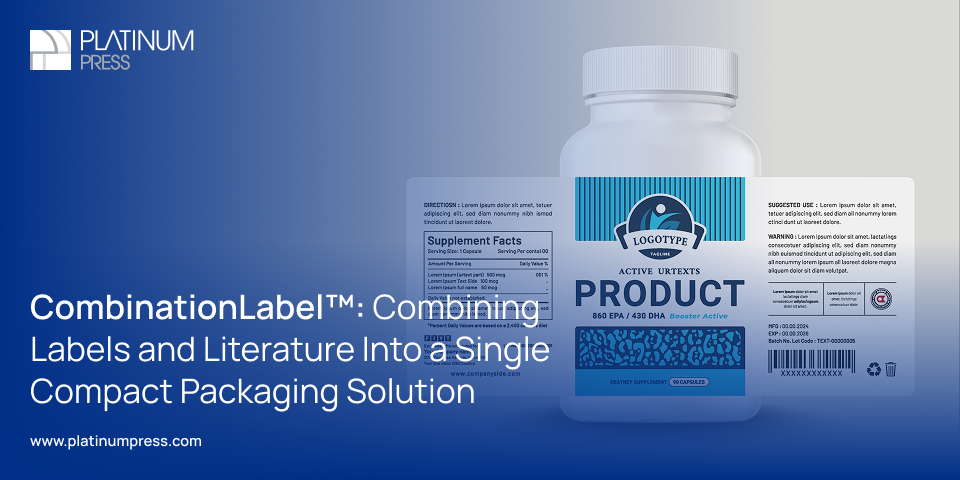
CombinationLabel™: Combining Labels and Literature Into a Single Compact Packaging Solution
As pharmaceutical products become more complex, the amount of information required on pharmaceutical labels continues to grow. Instructions for use, safety information, regulatory content, multilingual text, and patient guidance all need to accompany the product. At the same time, packaging sizes continue to shrink, particularly for bottles, vials, and other round containers where label space is limited.
CombinationLabel™ was developed to solve this challenge. As a patented innovation from Platinum Press, CombinationLabel™ integrates pharmaceutical literature directly into the product label, creating a single compact component that delivers both labeling and regulatory information while maintaining packaging efficiency.
This approach provides the expanded information capacity associated with expanded content labels and extended content labels without requiring separate literature components.
What Is CombinationLabel™?
CombinationLabel™ combines a pressure-sensitive product label and pharmaceutical literature into a single integrated component. Rather than managing separate pharmaceutical labels and inserts, manufacturers can consolidate both functions into one solution.
The result is a compact package that provides expanded information capacity without requiring additional packaging components. Like other expanded content labels, CombinationLabel™ accommodates more information than a conventional single-panel label.
This approach helps simplify packaging while maintaining compliance with increasingly complex pharmaceutical labeling requirements.
CombinationLabel™ is part of a broader range of innovative packaging solutions developed to address the needs of pharmaceutical manufacturers.
Why Pharmaceutical Packaging Needs More Information
Today’s pharmaceutical products often require significantly more information than traditional pharmaceutical labels can accommodate.
Packaging may need to include:
- Directions for use
- Warnings and precautions
- Multilingual content
- Regulatory disclosures
- Product-specific instructions
- Patient support information
For products packaged in small bottles or round containers, available label space can quickly become a limitation. Extended content labels and booklet labels are among the formats manufacturers may consider when additional information is required. CombinationLabel™ provides a practical solution by expanding information capacity while maintaining a manageable package size.
Maintaining readability is equally important. High resolution pharmaceutical printing can help preserve clarity when labels contain dense instructions, warnings, and multilingual text.
Eliminating the Need for Separate Literature Components
Traditional packaging formats often rely on separate inserts, leaflets, or outserts to communicate required information. While effective, these additional components introduce complexity.
Each component must be:
- Procured separately
- Managed separately
- Inspected separately
- Reconciled separately
- Integrated during packaging operations
CombinationLabel™ reduces this complexity by combining pharmaceutical labeling and pharmaceutical literature into a single component. For manufacturers evaluating expanded content labels, this integrated construction can reduce the need to manage separate literature components. This can help streamline packaging operations while reducing the number of materials that need to be managed throughout the supply chain.
Manufacturers comparing pharmaceutical packaging product options can evaluate labels, cartons, and literature formats based on their operational requirements.
Designed for Round Containers
One of the biggest challenges in pharmaceutical labeling is applying large booklet labels to round containers. Traditional booklet labels can create issues during high-speed application due to their size and construction.
CombinationLabel™ addresses this challenge through patented tension release technology specifically designed to support machine application on round containers. This allows larger booklet-style constructions to be automatically applied while maintaining consistent performance during packaging operations.
Unlike conventional multi ply labels, which may use multiple printable layers, CombinationLabel™ integrates literature directly into its pressure-sensitive label construction. By enabling machine application of expanded content labels, manufacturers can gain additional information capacity without sacrificing packaging line efficiency.
Supporting Compliance Without Increasing Package Size
Regulatory requirements continue to evolve, particularly in global pharmaceutical markets where multiple languages and expanded disclosures are common. Increasing package size is not always practical.
CombinationLabel™ allows manufacturers to deliver more information within the existing package footprint, helping maintain compliance while avoiding larger cartons, additional inserts, or secondary packaging components.
By integrating pharmaceutical literature into the label, CombinationLabel™ provides the information capacity associated with expanded content labels and extended content labels while supporting complex pharmaceutical labeling requirements. For many applications, this can create a more efficient and user-friendly packaging solution.
Manufacturers should also consider pharmaceutical printing quality control to support accurate, consistent printed information across packaging components.
Improving Patient Access to Information
Patient information only provides value if it remains connected to the product. Because pharmaceutical literature is integrated directly into the label, critical information stays attached to the package throughout distribution, storage, and use.
Patients and healthcare providers have immediate access to important information without needing to locate separate inserts or leaflets. This is an important advantage of expanded content labels, particularly when pharmaceutical labels must accommodate detailed instructions and multilingual information.
This helps improve accessibility while ensuring information remains associated with the correct product.
Supporting Operational Efficiency
Combining multiple functions into a single packaging component can create benefits throughout the supply chain.
Potential advantages include:
- Reduced component counts
- Simplified inventory management
- Fewer packaging line operations
- Reduced reconciliation requirements
- Improved packaging efficiency
- Lower risk of component mismatch
By consolidating pharmaceutical labeling and pharmaceutical literature into one solution, manufacturers can simplify packaging workflows while maintaining regulatory compliance.
For manufacturers evaluating booklet labels, extended content labels, or other expanded-information formats, CombinationLabel™ offers a practical approach to reducing packaging complexity.
Selecting a pharmaceutical specific printing partner can also help manufacturers address documentation, inspection, and compliance requirements.
A Smarter Approach to Expanded Content Packaging
As pharmaceutical packaging requirements continue to grow, manufacturers need solutions that provide more information without adding complexity. CombinationLabel™ was developed to meet that need.
By integrating printed literature directly into the product label and utilizing patented tension release technology for machine application on round containers, CombinationLabel™ helps pharmaceutical companies maximize information capacity while maintaining operational efficiency.
This approach addresses challenges associated with applying larger booklet labels while supporting the information requirements of pharmaceutical label printing.
Other advanced pharmaceutical printing technologies can also help manufacturers balance print quality, material performance, and sustainability considerations.
The Platinum Press Difference
At Platinum Press, innovation is focused on solving real-world healthcare packaging challenges. CombinationLabel™ reflects that commitment by combining labeling and literature into a single compact component that supports compliance, patient access to information, and packaging efficiency.
For manufacturers seeking reliable pharmaceutical label printing solutions, CombinationLabel™ provides an integrated approach to managing expanded content without adding separate literature components. Because sometimes the best way to simplify pharmaceutical packaging is to combine what has traditionally been separate.
Manufacturers interested in CombinationLabel™ can contact our team to discuss labeling requirements, container compatibility, and suitable packaging solutions.
Frequently Asked Questions
What are expanded content labels?
Expanded content labels provide additional printable space for instructions, warnings, multilingual information, and other details that conventional labels cannot accommodate.
How does CombinationLabel™ differ from traditional booklet labels?
CombinationLabel™ integrates printed literature into a pressure-sensitive label and uses patented tension release technology to support automated application on round containers.
What are extended content labels used for?
Extended content labels accommodate detailed product information, including instructions, safety warnings, regulatory disclosures, and multilingual content within limited packaging space.
Can CombinationLabel™ replace separate pharmaceutical inserts?
CombinationLabel™ can reduce the need for separate inserts by integrating pharmaceutical literature directly into the product label for suitable applications.
Can CombinationLabel™ be applied to round containers?
Yes. CombinationLabel™ uses patented tension release technology to support automated application of larger booklet-style labels to round containers.
How does Platinum Press support pharmaceutical labeling?
Platinum Press developed CombinationLabel™ to integrate labeling and literature into one compact component, supporting information accessibility and packaging efficiency.