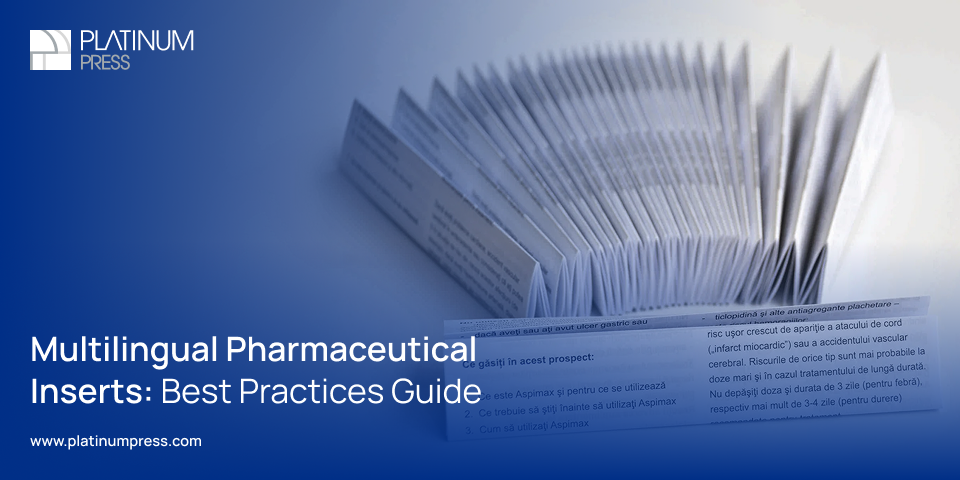
Multilingual Pharmaceutical Inserts: Best Practices Guide
Modern medications often include extensive prescribing information, dosage instructions, safety warnings, storage requirements, and regulatory disclosures. Providing accurate multilingual product information without compromising readability has become one of the biggest challenges in today’s pharma packaging industry.
Success requires far more than simply fitting additional text onto a page. Effective Multilingual packaging depends on thoughtful document design, precise formatting, professional label translation, and production processes that support both usability and regulatory compliance. As regulations evolve, multilingual labeling, multilingual packaging, and regulatory labeling translation have become essential components of modern packaging for pharmaceutical products.
Leading providers of pharmaceutical packaging solutions understand that every language version must communicate information with the same level of clarity and accuracy. At Platinum Press, multilingual pharmaceutical literature is produced with this objective in mind, helping manufacturers create reliable Multilingual packaging that supports both compliance and patient safety.
Organize Information Clearly
When pharmaceutical literature includes several languages, poor organization can make important information difficult to find. Clear document structure allows healthcare professionals, pharmacists, caregivers, and patients to navigate multilingual product information efficiently without unnecessary confusion.
Effective multilingual labeling also requires maintaining the same information hierarchy across every translated language. This consistency allows readers to locate dosage instructions, contraindications, warnings, and administration guidance regardless of which language they are using.
Professional label translation plays an important role throughout this process. Accurate translations preserve both the meaning and intent of regulatory content while supporting safe medication use.
Unlike general retail packaging translation, pharmaceutical literature requires specialized terminology and careful attention to regulatory language. Even small translation inconsistencies may affect comprehension, making regulatory labeling translation an essential part of developing compliant Multilingual packaging.
For manufacturers developing packaging for pharmaceutical products, organizing information effectively supports both regulatory compliance and a better patient experience. This is why many pharmaceutical packaging solutions incorporate structured document templates that improve consistency across multiple languages.
Maintain Readability
As more multilingual product information is added to pharmaceutical literature, designers often face pressure to reduce font sizes or compress layouts. Although these approaches may technically accommodate additional content, they frequently make critical information more difficult to read, particularly for elderly patients and caregivers.
Good multilingual labeling balances information density with readability. Clear typography, sufficient spacing, consistent alignment, and logical paragraph structure all contribute to literature that is easier to understand. High-resolution printing further improves legibility by ensuring small text remains crisp and well defined throughout production.
Professional label translation should also consider text expansion. Certain languages require significantly more space than others, making early planning an important part of successful multilingual labeling and packaging.
At Platinum Press, our approach to pharmaceutical packaging solutions emphasizes both readability and production quality, ensuring multilingual pharmaceutical literature communicates clearly regardless of language.
Plan Folding Around Content
Fold patterns should support how the literature will be read. Successful pharmaceutical literature design considers not only the printed page but also the final folded format. During production, fold placement directly affects how readers interact with multilingual product information once the document is unfolded.
Carefully planned Multilingual packaging also accounts for language grouping. Keeping related translations together improves navigation and allows patients to find the appropriate language more efficiently.
Design teams responsible for multilingual labeling and packaging frequently collaborate with production specialists to ensure fold patterns support both usability and manufacturing requirements.
At Platinum Press, document layouts are developed with both production and user experience in mind. Combined with professional label translation, specialized folding equipment, and comprehensive pharmaceutical packaging solutions, our process helps manufacturers produce literature that supports compliance throughout the packaging for the pharmaceutical industry.
Proper planning also distinguishes regulated pharmaceutical documentation from standard retail packaging translation, where production complexity and regulatory oversight are typically less demanding. Effective regulatory labeling translation combined with intelligent fold planning ensures multilingual literature remains accurate, organized, and easy to use from production through patient use.
Consider Automated Packaging Requirements
Large multilingual inserts often become thicker after folding. As additional multilingual product information and translated content are added, the finished literature increases in thickness and complexity. This can affect how inserts move through automated packaging equipment if the document has not been properly designed.
Planning Multilingual packaging with packaging line performance in mind helps ensure literature feeds consistently during automated insertion while minimizing production interruptions. Fold direction, paper selection, document thickness, and panel sequence all influence production efficiency.
Manufacturers developing packaging for pharmaceutical products should evaluate packaging-line requirements early in the design process. Small design adjustments can improve feeding performance while reducing waste and production downtime.
Professional multilingual labeling and packaging also requires close collaboration between design teams, translators, and production specialists. High-quality label translation ensures every language fits within the planned layout without disrupting fold patterns or packaging equipment.
Unlike retail packaging translation, which often prioritizes branding and consumer messaging, regulatory labeling translation focuses on maintaining technical accuracy while ensuring compatibility with pharmaceutical manufacturing processes.
At Platinum Press, automated production requirements are considered throughout the development of our pharmaceutical packaging solutions, helping manufacturers achieve reliable packaging performance while maintaining document quality across complex multilingual projects.
Quality Matters
Because multilingual product information communicates critical patient instructions, printing quality is just as important as accurate translation. Even perfectly translated content loses value if text is blurred, poorly registered, incorrectly folded, or difficult to read. Every stage of production contributes to the overall effectiveness of Multilingual packaging, making quality control an essential part of pharmaceutical literature manufacturing.
High-quality multilingual labeling depends on:
- Sharp, high-resolution printing
- Accurate registration
- Consistent color reproduction
- Precision folding
- Complete inspection
- Controlled documentation
Each of these elements supports clear communication while helping pharmaceutical manufacturers meet regulatory expectations. Professional regulatory labeling translation must also be supported by equally precise production processes. Accurate label translation alone cannot compensate for printing defects or folding errors that make information difficult to access.
Combined with advanced pharmaceutical packaging solutions, our production systems help manufacturers deliver reliable packaging for pharmaceutical products that communicate information accurately across multiple languages.
Why Multilingual Packaging Requires Specialized Expertise?
Every project involves balancing multilingual product information, regulatory requirements, patient usability, production efficiency, and packaging performance. As more products enter global markets, pharmaceutical manufacturers increasingly require Multilingual packaging that performs consistently throughout the product lifecycle.
Effective multilingual labeling and packaging depend on accurate label translation, well-organized layouts, intelligent folding strategies, and careful production planning. Together, these elements help reduce confusion while improving patient access to essential information.
This process differs significantly from standard retail packaging translation, where regulatory requirements and technical documentation are generally less demanding. Pharmaceutical literature instead relies on specialized regulatory labeling translation that preserves both scientific accuracy and legal compliance.
For organizations investing in high-quality pharmaceutical packaging solutions, multilingual literature should be viewed as an integral component of product safety rather than simply an additional printed document.
The Platinum Press Difference
At Platinum Press, we understand that multilingual pharmaceutical literature must communicate clearly while meeting the highest standards for quality, consistency, and regulatory compliance.
Our expertise in Multilingual packaging, advanced folding technologies, and pharmaceutical-focused production allows us to manufacture literature that supports patients, healthcare professionals, and pharmaceutical manufacturers worldwide.
Through comprehensive pharmaceutical packaging solutions, we help customers manage increasingly complex multilingual product information without compromising readability or packaging performance.
Our specialized approach to multilingual labeling, multilingual labeling and packaging, label translation, and regulatory labeling translation ensures pharmaceutical literature remains accurate from initial design through final production.
Frequently Asked Questions
Why is multilingual product information important in pharmaceutical packaging?
Multilingual product information helps patients and healthcare professionals access accurate instructions in their preferred language while supporting international regulatory compliance and safe medication use.
What makes multilingual pharmaceutical literature difficult to design?
Designers must balance readability, translation accuracy, folding requirements, packaging constraints, and regulatory compliance while fitting multiple languages into limited available space.
How does regulatory labeling translation differ from retail packaging translation?
Regulatory labeling translation prioritizes technical accuracy and compliance, while retail packaging translation generally focuses more on consumer marketing and brand communication.
Why should folding be considered during multilingual packaging design?
Proper fold planning keeps translated information organized, improves readability, supports automated packaging equipment, and prevents important content from disappearing within fold lines.
How does Platinum Press support multilingual pharmaceutical packaging?
Platinum Press provides advanced pharmaceutical packaging solutions, precision folding, and high-quality production that help manufacturers create reliable multilingual pharmaceutical literature.
Why is readability important for multilingual pharmaceutical inserts?
Clear typography, organized layouts, and accurate printing help patients quickly locate critical information, reducing confusion while supporting safe and effective medication use.