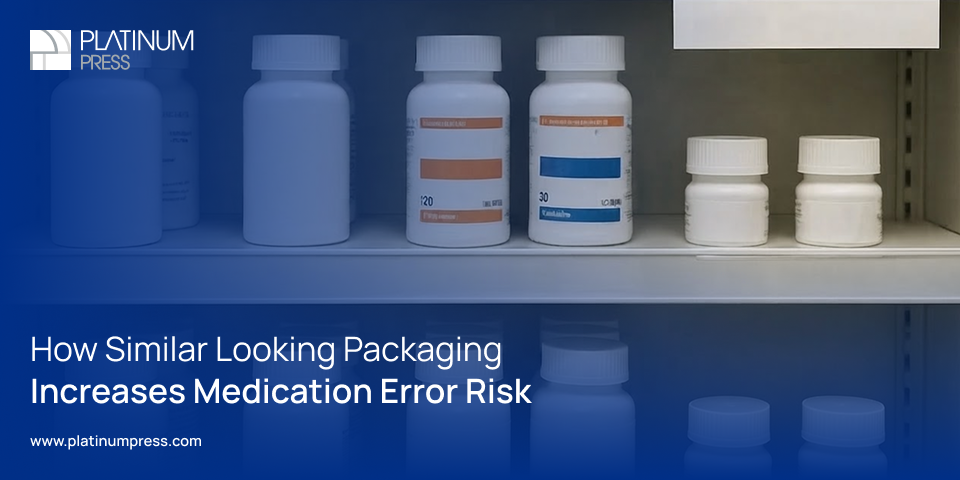
How Similar Looking Packaging Increases Medication Error Risk
Healthcare professionals, pharmacists, caregivers, and patients rely heavily on packaging to identify products quickly and accurately. When labels, cartons, or product presentations appear too similar, the risk of confusion increases, especially in fast-paced healthcare environments. Effective medication errors prevention begins long before a medication reaches the patient, and packaging is one of the first safeguards in that process.
Medication errors related to look-alike packaging and labeling have been recognized for years as a significant safety concern across the pharmaceutical industry. As pharmaceutical manufacturers continue investing in Pharmaceutical Printing Solutions, Custom and Contract Packaging Solutions, packaging design and print quality have become increasingly important tools for medical error reduction and prevention.
At Platinum Press, every packaging component is produced with the understanding that even small inconsistencies can contribute to medication mismanagement or become one of many real-world medication error examples seen throughout healthcare systems.
Packaging Is Part of the Medication Safety System
Packaging is often the first thing used to identify a medication. Before a barcode is scanned or a prescription is reviewed, healthcare professionals visually identify products by:
- Color
- Typography
- Layout
- Packaging structure
- Barcode placement
- Overall visual appearance
In hospitals, pharmacies, and retail environments, these visual cues help differentiate products quickly during dispensing and administration workflows. When multiple products or strengths appear too similar, the possibility of selecting the wrong product increases. This is why medication errors prevention starts with packaging that supports quick and accurate product recognition.
The FDA has specifically identified similar colors and packaging appearance as contributing factors in reported medication errors involving look-alike products. These findings reinforce why pharmaceutical manufacturers continue investing in high-quality Pharmaceutical Printing Solutions that improve visual differentiation while maintaining regulatory compliance.
For suppliers like Platinum Press, packaging is more than printed material. It is an important communication tool that supports healthcare professionals during critical moments and contributes to broader medical error reduction and prevention initiatives.
The Scope of the Problem
Research has also shown that packaging itself is frequently a contributing factor. In one five-year hospital study evaluating medication incidents, packaging contributed to more than 65% of identified LASA-related medication errors.
These risks become even more significant in:
- High-volume pharmacy environments
- Hospital dispensing systems
- OTC retail shelves
- Multi-strength product families
- Elderly patient populations
- Caregiver-administered medications
These statistics demonstrate why packaging should never be viewed only from a branding perspective. Poor differentiation can increase medication mismanagement, contribute to dispensing mistakes, and become one of many documented medication error examples across healthcare facilities.
Investing in well-designed Custom Packaging Solutions and reliable Contract Packaging helps manufacturers reduce these risks while strengthening medication errors prevention programs across the pharmaceutical supply chain.
Why Color Differentiation Matters?
Color is one of the most powerful visual identifiers in pharmaceutical packaging. Different strengths or formulations are often differentiated using color systems designed to help pharmacists, healthcare providers, and patients distinguish products quickly. But this only works if color remains consistent from run to run.
Even small color shifts can reduce visual differentiation between SKUs. When two strengths begin looking nearly identical, the possibility of selecting the wrong product increases significantly, creating opportunities for medication mismanagement and avoidable dispensing mistakes.
At Platinum Press, color is managed using G7-aligned workflows and spectrophotometric color measurement systems that objectively measure color throughout production.
Consistent color is an essential component of modern Pharmaceutical Printing Solutions because it supports both brand integrity and medical error reduction and prevention. It also helps ensure that Custom Packaging Solutions remain visually consistent regardless of production volume or reorder frequency.
In pharmaceutical packaging, consistent color is not just about branding. It helps maintain clear visual separation between products, supports medication errors prevention, and reduces the likelihood that packaging itself becomes one of many preventable medication error examples.
Typography and Readability Impact Safety
Poor contrast, crowded layouts, small text, or inconsistent hierarchy can make critical information harder to identify. These design issues may appear minor during development but can contribute to medication mismanagement once products reach pharmacies, hospitals, or patients.
Studies evaluating look-alike medication labels have repeatedly identified readability and label clarity as important factors in medication errors prevention. Clear typography, high-resolution printing, structured layouts, and properly organized information all support medical error reduction and prevention while improving overall usability.
For Platinum Press, typography is carefully managed as part of its Pharmaceutical Printing Solutions, ensuring printed labels, cartons, and literature communicate important information clearly. Combined with well-designed Contract Packaging Solutions, readable packaging helps healthcare professionals make faster and more accurate decisions in real-world environments.
Barcode systems have become one of the most effective safeguards against medication selection errors. While packaging design helps healthcare professionals visually identify products, barcode verification provides an additional level of accuracy that supports medication errors prevention throughout the medication use process.
Patient safety organizations and ISMP guidance continue to emphasize barcode scanning as a critical tool for medical error reduction and prevention, particularly in hospitals, pharmacies, and other high-volume healthcare settings.
At Platinum Press, barcode verification systems are integrated throughout production and inspection workflows to help ensure barcode clarity and consistency across printed packaging components. These advanced Pharmaceutical Printing Solutions verify barcode quality before products leave production, helping reduce the possibility of packaging defects becoming real-world medication error examples.
When combined with reliable Custom Packaging Solutions and Contract Packaging Solutions, barcode verification strengthens packaging accuracy while supporting broader medication errors prevention initiatives across the pharmaceutical supply chain.
Inspection Systems Reduce Human Error
Human inspection alone is no longer sufficient in pharmaceutical packaging. The human eye can miss subtle defects, especially during long production runs or when reviewing repetitive layouts across multiple SKUs. Fatigue, repetitive tasks, and visual similarities can all contribute to medication mismanagement if packaging inconsistencies go unnoticed.
To reduce this risk, Platinum Press utilizes 100 percent vision inspection systems across printing and finishing operations for labels, cartons, and literature.
Inspection systems compare printed components against approved PDF files to detect:
- Missing elements
- Color variation
- Registration shifts
- Barcode inconsistencies
- Print defects
- Incorrect artwork versions
Inspection continues throughout finishing and conversion processes to help ensure errors are identified before products move downstream. This significantly reduces reliance on subjective visual checks while supporting medical error reduction and prevention. It also strengthens the performance of Pharmaceutical Printing Solutions by ensuring consistency across production batches and repeat orders.
Automated inspection provides another layer of protection against medication error examples caused by incorrect artwork, missing information, or inconsistent packaging presentation. When integrated into Custom Packaging Solutions and Contract Packaging Solutions, these systems help pharmaceutical manufacturers maintain confidence in every printed component.
Packaging Design Must Consider Real-World Conditions
Instead, it is handled during emergencies in hospitals, stocked on crowded pharmacy shelves, transported throughout complex distribution networks, and read by elderly patients or caregivers at home. These real-world conditions make clear packaging design essential for medication errors prevention.
This requires disciplined production controls, strong product differentiation strategies, consistent color management, readable typography, barcode verification, and automated inspection. Together, these elements support medical error reduction and prevention while helping manufacturers avoid costly packaging-related medication error examples.
At Platinum Press, these principles guide the development of Pharmaceutical Printing Solutions, Custom Packaging Solutions, and Contract Packaging Solutions that prioritize both regulatory compliance and patient safety.
Packaging Quality Is Ultimately About Patient Safety
At Platinum Press, packaging quality is approached with the understanding that labels, cartons, and literature directly influence how products are identified, dispensed, and used. Through G7 color control, spectrophotometric color measurement, barcode verification, PDF comparison systems, and 100 percent vision inspection during both printing and finishing, Platinum Press helps reduce packaging inconsistencies that may contribute to medication mismanagement or become preventable medication error examples.
Effective Pharmaceutical Printing Solutions extend beyond producing visually attractive packaging. They help healthcare professionals distinguish products accurately, support regulatory compliance, and contribute to ongoing medical error reduction and prevention efforts throughout the pharmaceutical supply chain.
Similarly, carefully designed Custom Packaging Solutions improve product differentiation across multiple strengths, formulations, and product families, while dependable Contract Packaging Solutions help manufacturers maintain consistency across commercial production.
Frequently Asked Questions
Why does similar packaging increase medication error risk?
Similar packaging can make products difficult to distinguish quickly, increasing the likelihood of selecting the wrong medication, particularly in busy healthcare environments where rapid identification is essential.
How does color consistency help prevent medication errors?
Consistent color helps differentiate products, strengths, and formulations, allowing pharmacists and healthcare professionals to identify medications more accurately during dispensing and administration.
Why are barcode verification systems important?
Barcode verification confirms printed barcodes remain readable and accurate, supporting scanning systems that help reduce medication selection errors and improve patient safety.
How do automated inspection systems improve pharmaceutical packaging?
Automated vision inspection identifies print defects, artwork changes, barcode issues, and color variations before products leave production, reducing reliance on manual visual inspection.
What role does typography play in medication safety?
Clear typography improves readability of dosage instructions, warnings, and product information, helping healthcare professionals and patients identify medications more accurately and confidently.
Why does Platinum Press focus on patient safety during printing?
Platinum Press combines advanced inspection, color management, barcode verification, and controlled Pharmaceutical Printing Solutions to help reduce packaging inconsistencies that could contribute to medication errors.